
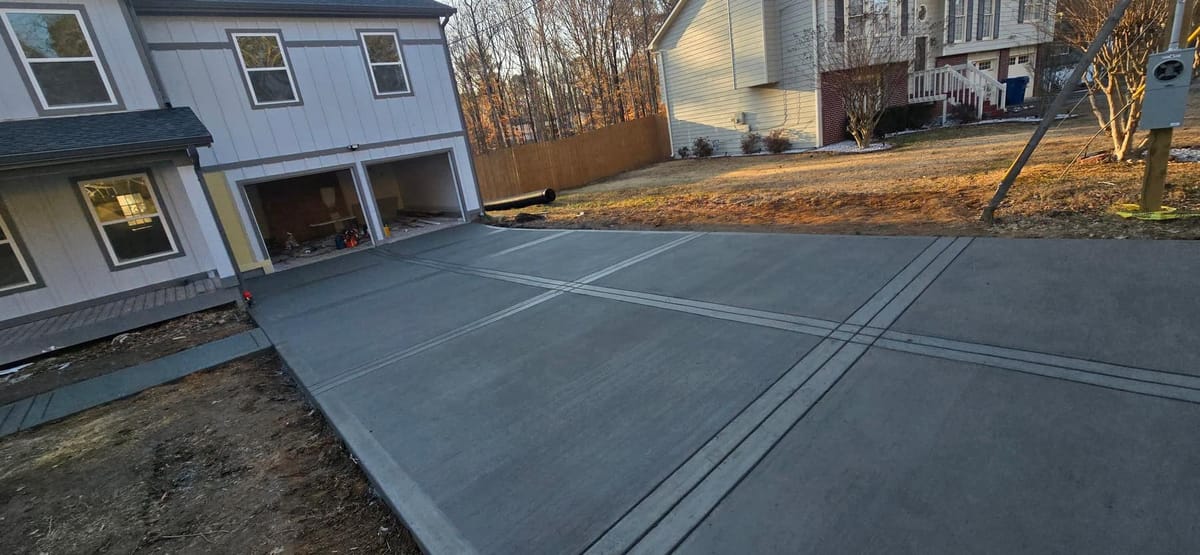
Finished driveway with cut control joints, Duluth, Georgia
The edge fails before the middle
A driveway is the only slab on a property that gets a wheel load driven along its outside edge, and that's where almost all of them break first.
Northwest Georgia and the north Atlanta metro
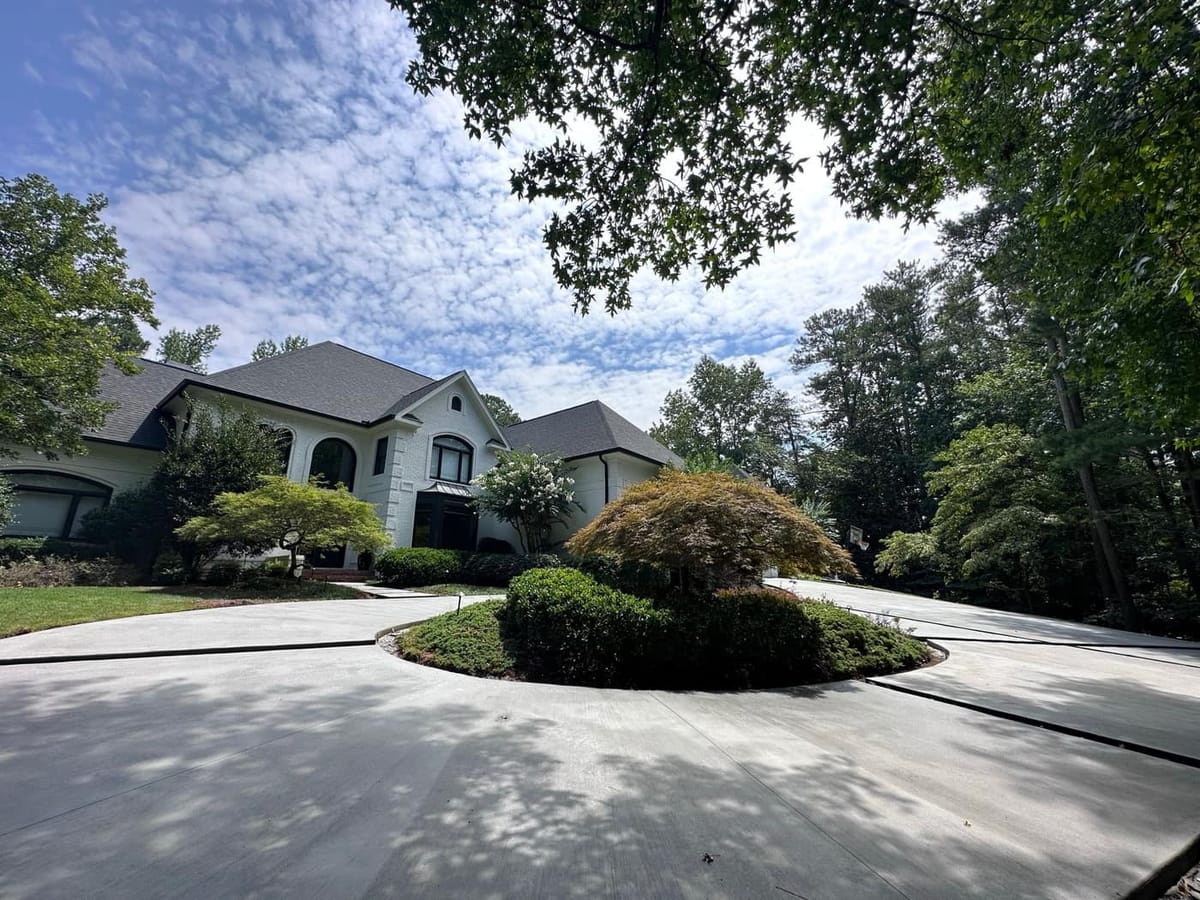
Walk on a patio and the load is spread over your feet, in the middle of the panel, going straight down. Drive onto a driveway and the load is a few square inches under each tire, moving, often turning, and frequently running along the outer edge. Turning is the part people miss.
A wheel that's rolling pushes down. A wheel that's turning while stopped grinds sideways, and sideways is the direction concrete doesn't like.
That's why the tightest spot on most drives, where cars swing in from the street, is the spot that shows wear first.
Picture a slab from the side. In the middle, load goes down into ground that's confined on every side and has nowhere to escape to.
At the edge, the soil under the slab can move sideways into the open air beside it. Over time that soil creeps outward and settles, and now the outer strip of the slab is spanning a gap. The next heavy wheel that runs along it breaks a piece off, usually in a long line parallel to the edge.
The fix isn't more concrete. It's carrying the compacted base out past the edge on both sides, so the ground beside the slab is as firm as the ground under it. It's cheap while the machine is on site and impossible afterward.
A driveway is a long, narrow slab, and long narrow slabs crack across themselves. Concrete shrinking along a twenty foot length has far more total movement to relieve than the same concrete shrinking across a ten foot width.
Left as one long strip it'll find a line somewhere in the middle and split. Cutting joints so the panels come out roughly square gives the shrinkage in both directions somewhere to go. On a wide drive that means joints running the length as well as across, which is why a well jointed driveway looks like a grid, not a ladder.
Two ends of a driveway are fixed before work starts. The garage floor is at the height it's at, and the street is at the height it's at.
Everything in between is a decision, and the decision has to move water away from the building. Where the drive butts the garage slab, the two are separated, not joined, because the house and the driveway sit on different ground and settle at different rates. Tie them together and the movement has to go somewhere, and where it goes is a crack a foot inside the door.
A thin overlay on a broken drive is the cheapest thing anyone can offer and the shortest lived. Every crack underneath telegraphs through, usually within a year, and now there are two layers to remove instead of one. If the base is what failed, and on a cracked driveway it usually is, the base is the thing that has to be fixed.
Breaking out is also the only moment the drainage can be corrected, which matters if the old drive was sending water toward the house.
For the general principles behind any pour, including how curing decides surface durability, see concrete contractor. For pads, patios and flatwork, not a drive, see concrete slabs. If the ground has to be held before the drive can be built, that's retaining walls. If you would rather have laid units than a poured surface, compare patios, walkways and steps.
Our work
Finished driveway with cut control joints, Duluth, Georgia
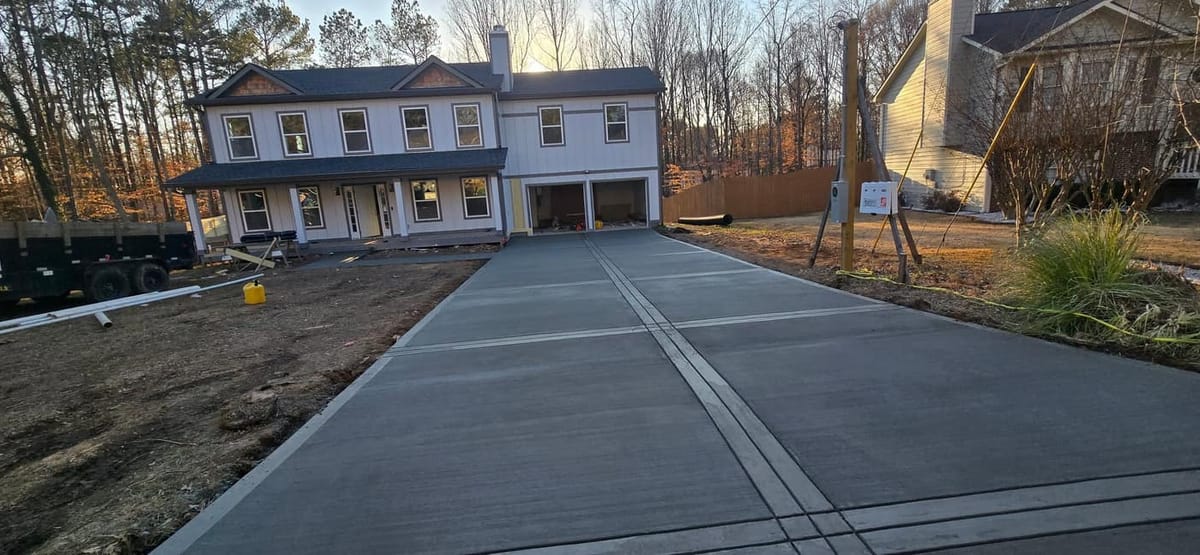
Wide drive running to the double garage, Duluth, Georgia
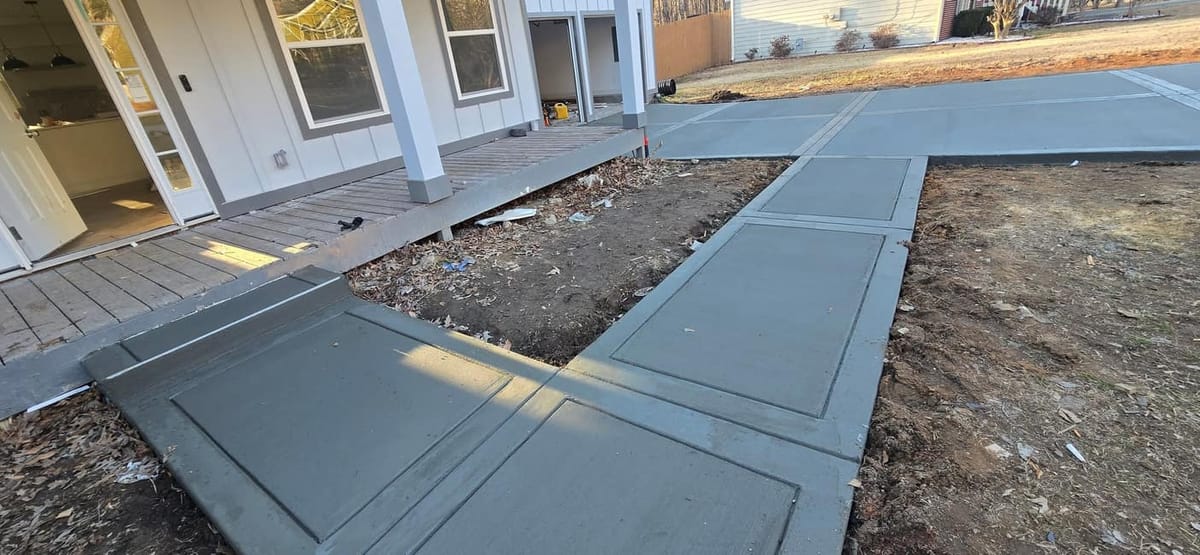
Finished walkway to the front door, Duluth, Georgia
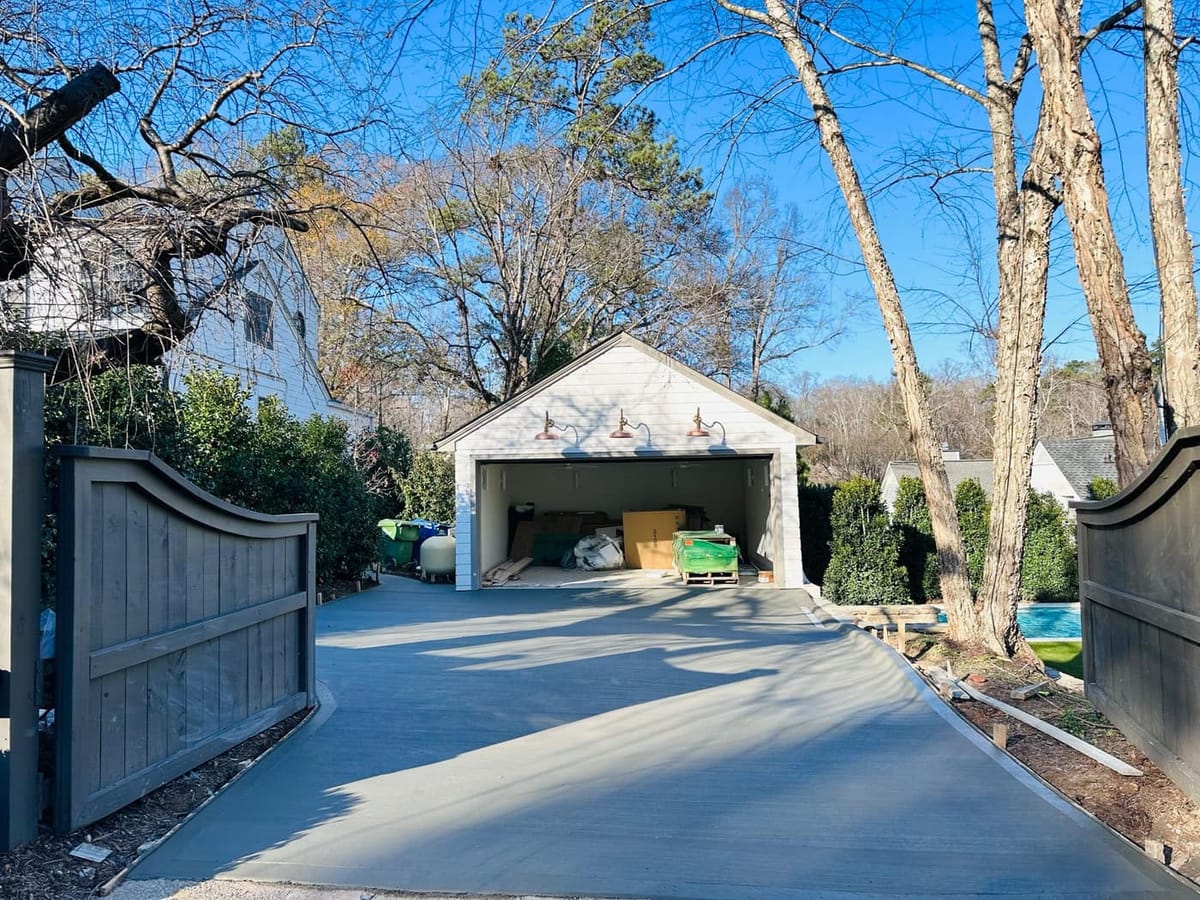
Finished drive running to the detached garage, Marietta, Georgia
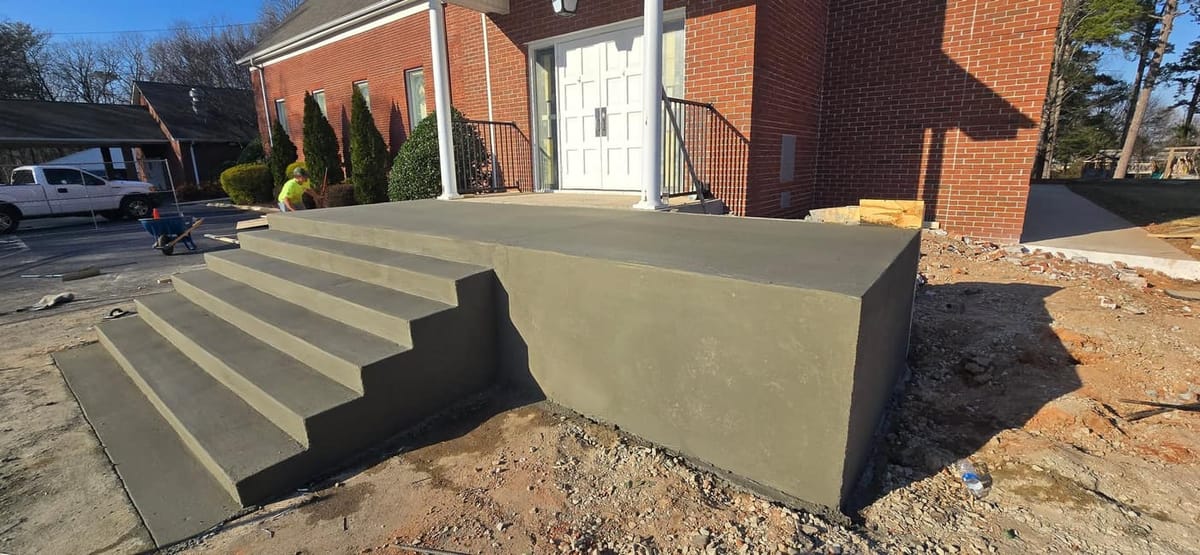
Finished steps and landing, Smyrna, Georgia
Three quick steps. We call you back ourselves, and nothing here commits you to anything.
We call back ourselves, so the number that rings you will be (706) 879-8873. If you would rather not wait, call us now at (706) 879-8873.
Got a photo of the spot? Text it to (706) 879-8873. It answers more than a paragraph does, and it reaches the same phone as your request.
What actually happens
The route comes out to firm ground and gets shaped to fall the way the finished surface needs to fall. Fixing the slope with extra concrete instead of shaping the subgrade means paying concrete prices to do the job of dirt.
The compacted base runs wider than the concrete on both sides. A slab whose base stops exactly at the form has nothing supporting the ground beside it, and that's the ground a tire loads every time it turns in.
Where the drive meets the street or the garage floor, the levels have to be planned before anything is poured. Those two points are fixed by things already built, and everything between them is set to suit.
Working the surface while bleed water is still sitting on it drives that water back into the top of the slab and weakens it. Finishing waits for the sheen to go, which on a hot day is a much shorter window than people expect.
Panels are cut roughly square, not long and thin, because a long narrow panel cracks across its middle to make itself into two squares. The joint pattern is set out before the saw comes out.
Questions we get asked
Thicker than a walkway, and thicker again wherever a heavy vehicle actually stops instead of passes. The car in the garage is rarely the load that decides it. A delivery truck, a moving van or a loaded trailer parked in one spot is what a driveway has to survive, and those turn up a few times a year whether or not they were planned for.
Because the edge is the least supported part of the slab and the most loaded. A tire tracking near the side puts weight on concrete that has ground under it on one side and open air on the other. If the compacted base wasn't carried out past the edge, the soil there settles, the slab loses its bearing and the edge breaks off in a line.
Yes, and the new strip is kept as its own slab, not tied into the old one. Two pours of different ages move differently, so bonding them just transfers the movement into a crack. Jointed properly at the seam, the widening reads as part of the pattern.
It takes the heaviest turning loads on the whole drive, because every vehicle pivots there on its way in and out. It's also the one part of the run that's not really yours, since it sits in the right of way, not on the property. For both reasons it gets priced as its own piece of work, and we bring it up before quoting.
Not if the fall is set before the pour. The surface has to move water away from the door, and the level at the door is fixed by the building, so the slope has to be worked backward from that point. This is decided with a level on the day, not by eye, because a drive that looks flat can still run the wrong way.
They fail differently. Concrete is rigid, lasts a long time and is expensive to repair in a way that matches. Asphalt is flexible, more forgiving of ground movement, and needs periodic attention to stay sealed. On red clay that shrinks and swells with the season, that flexibility is a genuine argument, and so is the fact that a concrete drive rarely needs anything done to it.
Where we work
Tell us how long the run is and what the heaviest thing to park on it'll be.