
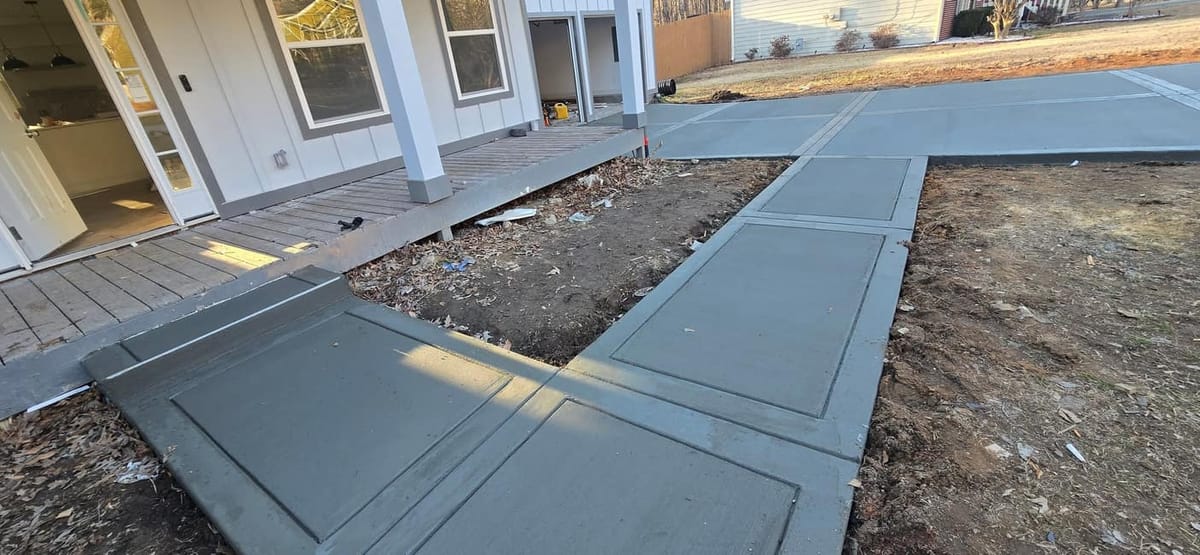
Finished walkway to the front door, Duluth, Georgia
Everything is in the base
A paver patio is a floor with no glue holding it together. What keeps it flat is entirely what's underneath and around it.
Northwest Georgia and the north Atlanta metro
The visible part of a paver patio is a single course of units sitting loose on sand. Under it there's either a properly built base or there's not. On the day the job finishes you can't tell the difference.
That's the whole reason two quotes for the same patio can be so far apart. One includes several inches of compacted stone and a day of machine time. The other includes sand on dirt.
A base does two jobs at once. It spreads load, so a foot or a table leg pressing on one paver is carried by a wide patch of ground, not a small one. And it drains, so water soaking through the joints keeps moving down and away instead of sitting under the surface. Water held under a patio is what freezes, what softens the subgrade, and what carries fine material out sideways.
Crushed angular stone does both, because the pieces lock together mechanically while the gaps between them stay open. Rounded gravel does neither well. It rolls instead of locking.
Firmness comes from vibrating stone into itself in shallow depths. Put down a deep layer, run a compactor over the top, and only the top few inches respond. Everything below stays loose and settles later, unevenly. That's what gives a patio a dish in the middle after a couple of wet winters.
So the work goes in passes. Spread, compact, spread, compact. The fall gets checked each time, so the finished surface slopes the way it's supposed to instead of the way the ground happened to.
A field of pavers has no mortar. It stays together because every unit is wedged against the ones beside it and the whole assembly is held in at the perimeter.
Take the perimeter restraint away and the outer course has nothing pushing back. It moves outward a fraction under every load. The joint behind it widens, the sand in that joint washes out, and the loosening travels inward one course at a time. Nobody watches a patio fail from the edge in. They notice, a few years later, that it feels loose.
A walkway is narrow, which means almost all of it is edge. The restraint that's one detail on a patio is most of the structure on a path.
A curve adds a second problem. Cutting units to follow it leaves small pieces at the perimeter, and small pieces at an edge are the first things to shift. Paths also carry water.
A walkway crossing a slope is a channel unless it's built to shed sideways. A route that collects runoff and delivers it to the back door is a common and expensive mistake.
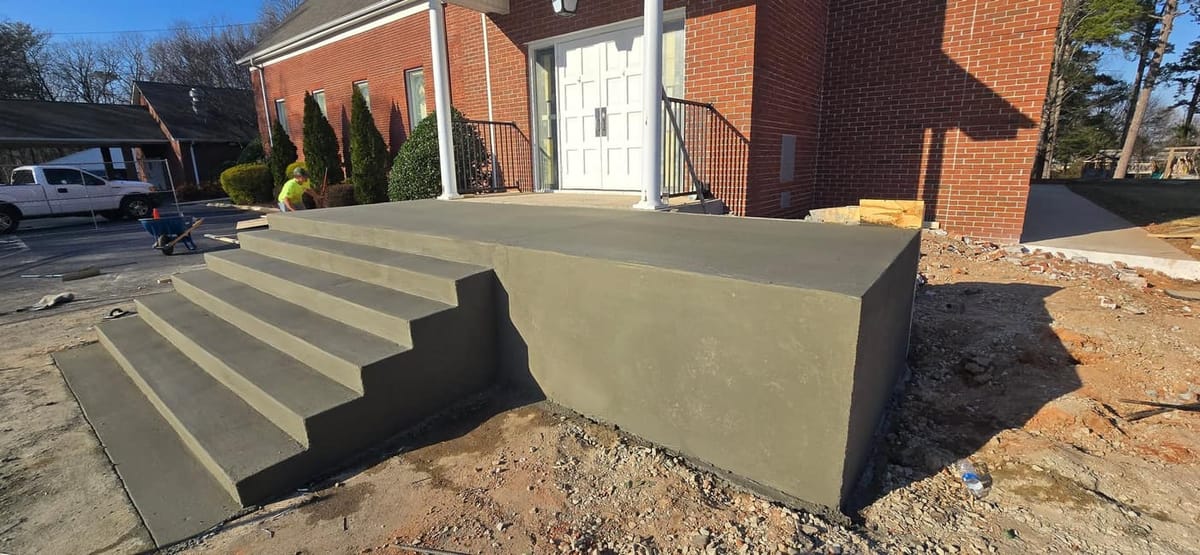
Stone or block steps aren't stairs bolted to anything. Each one is a small structure carrying the ones above it.
So every tread sits on its own compacted base, and every riser is bedded, not balanced. The failure to plan for is at the two ends. A step run needs a flat, drained place to arrive at, top and bottom. Steps that end directly in a lawn sink at the bottom tread within a season or two.
A fire pit is a short circular wall, and everything on this page applies to it at a smaller radius. It needs its own compacted footing, because a ring of block on unprepared soil settles unevenly and the top course goes out of level in a way that's very visible.
It's far cheaper to build while the patio around it is open than to retrofit into a finished surface, and where it sits relative to the seating, the house and the prevailing wind is worth deciding early.
If the flat ground has to be created first, that's retaining walls. If the space would be better raised than paved, compare it against deck building. Shade over a finished patio is pergolas and patio covers, and closing it in is screened porches and enclosures.
For layouts, shapes, paver patterns and what each one does to where the water goes, read patio and walkway design ideas. For the whole yard, not one surface, backyard ideas for small and sloped yards. For what moves the number, what sits under a patio quote.
Our work
Finished walkway to the front door, Duluth, Georgia
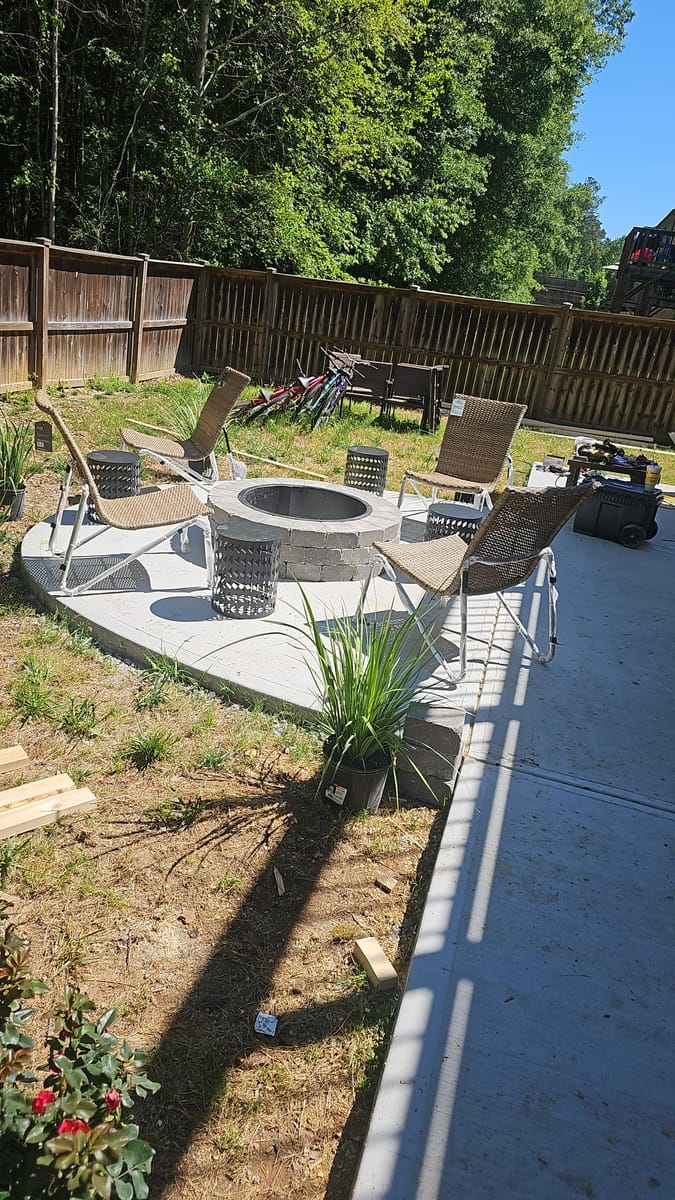
Fire pit and seating on the patio below, Cumming, Georgia
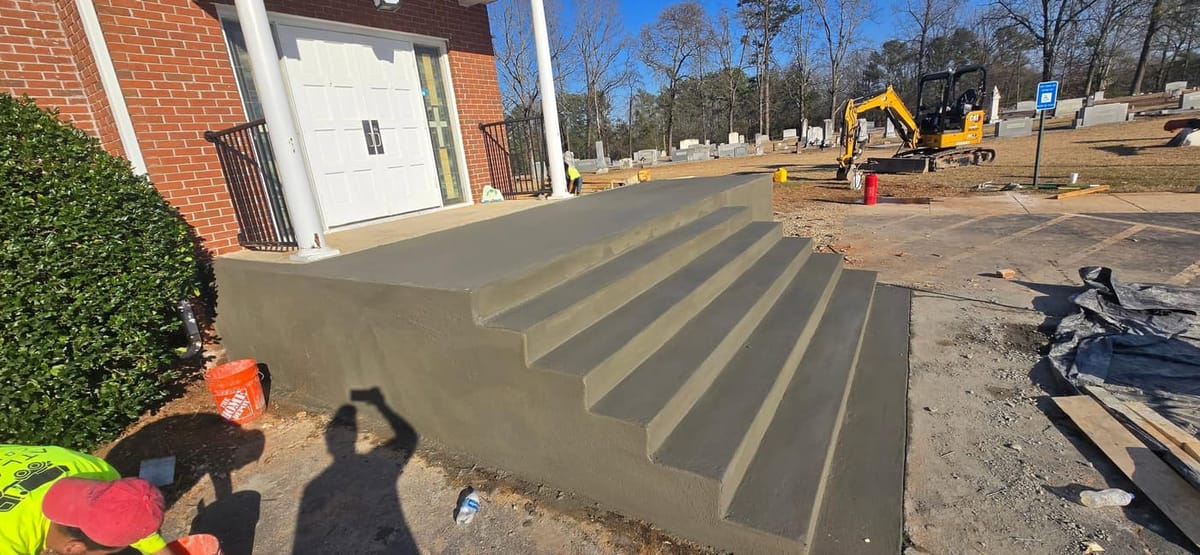
Finished steps after the forms came off, Smyrna, Georgia
Three quick steps. We call you back ourselves, and nothing here commits you to anything.
We call back ourselves, so the number that rings you will be (706) 879-8873. If you would rather not wait, call us now at (706) 879-8873.
Got a photo of the spot? Text it to (706) 879-8873. It answers more than a paragraph does, and it reaches the same phone as your request.
What actually happens
Topsoil is organic and it'll keep decomposing and settling under anything laid on it. It comes off until what's left is subgrade that doesn't move, and how deep that is varies from yard to yard.
A geotextile between the soil and the aggregate stops the two mixing. Clay pumping up into the stone during a wet spell is what turns a good base into a soft one.
Crushed stone goes down in shallow depths and each one is run over with a plate compactor before the next arrives. A deep layer compacted once is firm on top and loose underneath.
A thin, even bedding layer is struck off flat just in front of the work. Walking on screeded bedding ruins it, so it's prepared in strips, not across the whole patio.
Something solid has to hold the outer course from spreading sideways. Then sand is swept into the joints and vibrated in, which locks the field together so the surface behaves as one piece.
Questions we get asked
Almost always the base under that corner. Either it was never compacted properly, or organic material was left under it and has rotted down, or water runs to that corner and has washed fines out from under the pavers. The pavers themselves are rarely at fault.
Concrete is one continuous surface, which is fast and clean and will crack somewhere eventually because that's what a large slab does. Pavers move slightly with the ground and can be lifted and reset in one area. If anything is likely to be dug up later, pavers are far more forgiving.
No, and a level patio is a defect. A hard surface has to shed water, so it needs a consistent fall away from the house. It should be gentle enough that furniture sits flat and definite enough that a puddle never has a reason to form.
It's the barrier along the outside of the paved area that stops the perimeter course walking outward. It can be left out and the patio will look identical on the day it finishes. A couple of seasons later the joints on the outside open up and the field starts to loosen from the edge inward.
Sometimes, if the slab is sound, drains the right way and the extra height doesn't put the finished surface too close to a doorway or a siding line. If the slab is already cracked and moving, laying over it inherits the problem.
Yes, as part of a patio or as a standalone. A built pit is a small circular wall on its own compacted footing, so it's the same base work as everything else on this page at a smaller scale, and it's far easier to build while the patio around it is open.
Tell us roughly how big, and where the water goes now when it rains hard.