
Patios, walkways and steps
Patio and Walkway Ideas
A patio is a surface that won't absorb rain, and a walkway is a line across a grade. Both of them change where water goes. Design them knowing that and they age well.
Updated August 2026
Start where the water goes
Every square foot of patio is a square foot of yard that has stopped absorbing rain. Put down four hundred square feet of pavers and every storm now has four hundred square feet of runoff to send somewhere.
So the first question in any patio layout isn't what shape. It's where the water leaves.
Three answers work. It sheds into planting that can take it. It runs to a swale or a low corner that already handles water. Or it's collected and piped away.
What doesn't work is a surface with nowhere to send the water, because that's how patios end up with a green line down one edge and a damp wall behind them.
The creeks and branches running through this part of Georgia tell you roughly where a lot of these yards already drain. The patio should join that route, not fight it.
Fall, and how little of it you need
A patio has to be pitched, and the pitch is small enough that nobody notices it underfoot. It's enough that a spilled drink runs off one way and doesn't sit.
Two practical points.
Pitch away from the house. Every time. This is the single most common defect in owner-built patios and it's unfixable without lifting the surface.
Pitch in one plane, not four. A patio that falls in every direction from a high point looks like a hill and drains into all four of its edges. Pick one edge as the low side and go there.
Shape
Four shapes cover almost everything, and each has a consequence for how it drains and how much it costs in cuts.
- Rectangle. Fewest cuts, cleanest fall, and it aligns with the house. Boring isn't the same as wrong.
- Rectangle with a clipped corner. Takes the hard edge off, opens a route out to the lawn, and costs one angled cut line.
- Curved. Every unit along the curve is cut, so the labor rises. Curves also collect water in their inside corners unless the fall is thought through.
- Two zones at different levels. The right answer on a slope. It buys usable area without the fill and wall a single large flat surface would need. Each level gets its own fall, which is easier than pitching one enormous plane.
If the ground drops enough that a second level needs holding, a low wall comes into it, and the wall wants to be planned with the patio, not after it.
Paver patterns, and what each one is for
| Pattern | Reads as | Cuts | Best used |
|---|---|---|---|
| Running bond | Calm, linear | Fewest | Large fields, walkways, tight budgets |
| Herringbone | Busy, strong, interlocked | Most, at the edges | Driveways, anything taking weight, breaking up a grid |
| Basketweave | Traditional, small scale | Few | Small patios and courtyards |
| Ashlar or random | Stone-like, informal | Depends on the unit | Where a natural look is wanted without flagstone prices |
| Large format | Modern, calm, wide | Few, but expensive ones | Contemporary houses, and it makes small spaces look larger |
Two rules that are worth more than the pattern choice itself.
Turn the pattern to the house, not to the yard. A field laid at forty five degrees to the house wall hides the fact that most yards aren't square, and it stops the eye running straight out to the fence.
Put a border on it. A soldier course in a slightly different unit around the edge does three jobs: it hides every cut, it visually contains the field, and it gives the edge restraint something solid to hold. It's one of the cheapest upgrades in hardscape.
Concrete, and how to keep it from looking like a slab
Poured concrete is the cheapest way to get a large flat surface and it doesn't have to look industrial.
- Broom finish is the default. Direction of the broom is a design decision, and running it across the patio instead of along it makes a narrow slab look wider.
- Stamped patterns cost more and are convincing at a distance. Up close, the giveaway is repetition, so bigger patterns on bigger areas.
- Exposed aggregate is the most textured and the most slip resistant, which matters near a pool.
- Saw cut joints should be part of the design. Concrete will crack, and the joints decide where. A grid of deliberate joints reads as a pattern. An unplanned crack reads as a fault.
On the heavy clay through much of this part of Georgia, ground movement is real. That's the main argument for pavers: a paver field flexes with the ground and any settled area can be lifted and reset. A slab does neither. What separates the two on price is a separate question with a longer answer.
Walkways: follow the line people already walk
Go outside and look at the grass. There's usually a worn line across it, and it's almost never where a plan would have drawn the path.
Build the route people already take. A walkway that ignores that line gets walked beside, and you end up maintaining both.
Width matters more than material. Three feet carries one person. Four feet lets two walk together, which is what a front walk is for. Under thirty inches, people step off it.
Three other ideas that make a walk work:
- Curve for a reason. A curve around a tree or a bed makes sense. A curve across open lawn looks like decoration and people cut the corner.
- Widen where it arrives. A landing at a door or a gate, wider than the walk itself, is where people stand to open things. Without it, two people end up on the grass.
- Give the walk its own fall. A walkway across a slope becomes a small dam if it's laid flat into the hill. Water should cross it, not collect above it.
Steps and level changes
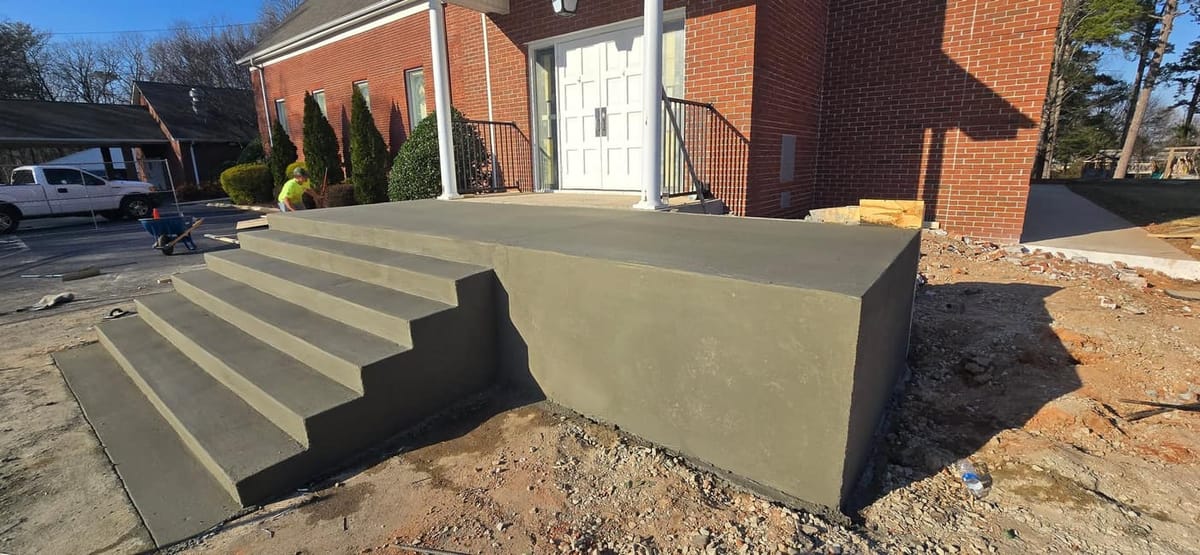
Grade transitions are where hardscape gets uncomfortable, and the fix is nearly always the same: fewer, deeper steps.
A broad step with a generous tread reads as part of the patio. A narrow, steep flight reads as a ladder. Where the drop is small, one wide step in the surface is better than a ramp and better than two mean little ones.
Where a level change is large enough that the ground needs holding, it becomes a wall job as well as a surface job, and the two get built together. That sequence is covered in the sloped yard guide.
Small patios
Three moves make a compact patio feel bigger.
- Run the pattern diagonally. It stops the eye reaching the edges so quickly.
- Use a larger unit. Small pavers on a small patio produce a lot of visual noise.
- Take the patio right up to a boundary and don't leave a strip of grass. Leftover strips make everything read smaller and nobody stands on them.
What goes over the patio
A surface with nothing above it gets used less than one with something overhead, and in a Georgia summer that difference is large.
- An open pergola for shade. Rain goes straight through, so the patio still has to shed water.
- A solid patio cover for a dry spot. It concentrates roof runoff at its edge, so where that water lands becomes part of the drainage plan.
- A screened enclosure if the reason you do not use the patio is insects, not sun.
Which one suits you is a question of what you're trying to keep off. The pergola guide covers shade, and the porch guide covers the three routes to an enclosed room.
Edges, borders and what the patio meets
Patios are judged at their edges. Three that come up:
Meeting the lawn. A border course set slightly proud of the grass keeps the mower off the edge. Set flush, it keeps the mower happy and buries slowly.
Meeting a deck. Where a deck steps down onto a patio, the patio should start a fraction below the bottom of the framing so water never sits against wood.
Meeting a fence. Paving right up to a fence line puts runoff at the base of the posts, which is exactly where posts rot. Leave a strip that can drain, or pitch away from the fence.
If the fence is going in at the same time, the style guide covers which patterns suit a boundary you'll be looking at from the patio.
Lighting the route
Light the steps and the changes of direction. Leave the rest of the surface dark.
Path lights every few feet down both sides of a walk look like a runway and glare into your eyes at walking height. Two lights at the level change, and one where the walk turns, does the whole job.
Where to start
Take a photo in the rain. Then measure the furniture you want on the patio, add walking room, and mark out the shape with a hose or a line of flour before anybody quotes it.
We build patios, walks, steps and the walls that hold them across the area we cover, including Smyrna and Mableton. Send the wet-day photo and the rough dimensions, and you'll get a straight answer about whether the layout you want will drain. Ask us here.
Want a straight answer for your own yard? Call (706) 879-8873 and talk it through with Hervin Ramirez, or send the details over and we will call you back.
Our work
Our completed work
Layouts
Shapes, routes and where the water went
- Rectangular paver patio pitched a quarter bubble away from the house, shedding into a planted strip that does the soaking up.
- Soldier course border in a darker unit. It hides the cut line, holds the field tight, and costs almost nothing extra.
- Walkway following the line people were already wearing into the grass instead of the line the plan drew.
- Two patio zones at different levels, split by three broad steps, because one flat surface would have needed a wall to exist.
- Herringbone laid at forty five degrees to the house wall. More cuts at the edges, and it stops the patio reading as a grid.
- Flagstone landing at a side gate, set on a base and swept, with a fall away from the fence line.
Common questions
Questions people ask about this
Which way should a patio slope?
Away from the house, always, and into something that can absorb or carry the water. A patio pitched flat looks level and puddles. A patio pitched toward the house moves rain to the one place you don't want it.
How wide should a walkway be?
Three feet is a path for one person. Four feet lets two people walk side by side, which is what a front walk should do. Anything under thirty inches gets walked beside instead of on.
What's the best paver pattern?
Running bond for a calm surface and the fewest cuts. Herringbone where the patio takes vehicle weight or where you want the eye to stop reading a grid. Basketweave for a traditional look on a small area.
Paver patio or concrete?
Pavers move with the ground and can be lifted and reset. Concrete is one piece, which is cheaper to place and cracks where the ground moves. On clay that shrinks and swells, that difference matters.
Can I put a patio where water already stands?
Not without dealing with the water first. A hard surface over a wet spot moves the problem sideways, and usually toward a neighbor or a foundation.