
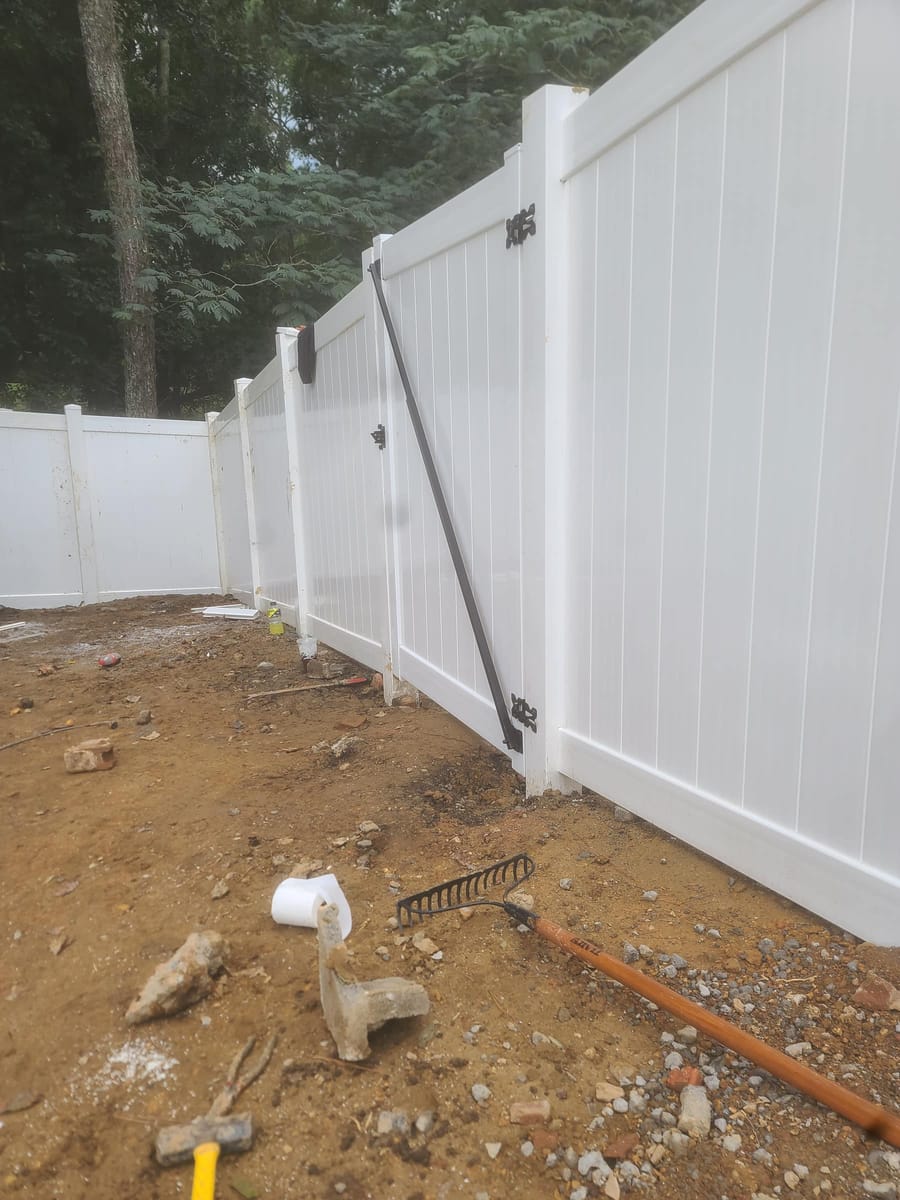
White vinyl privacy fence with braced gate, enclosing a wooded rear garden, Dalton, Georgia
Every fence, start to finish
A fence is a row of posts. Everything else is what you hang on them, and everything that goes wrong starts underground.
Northwest Georgia and the north Atlanta metro
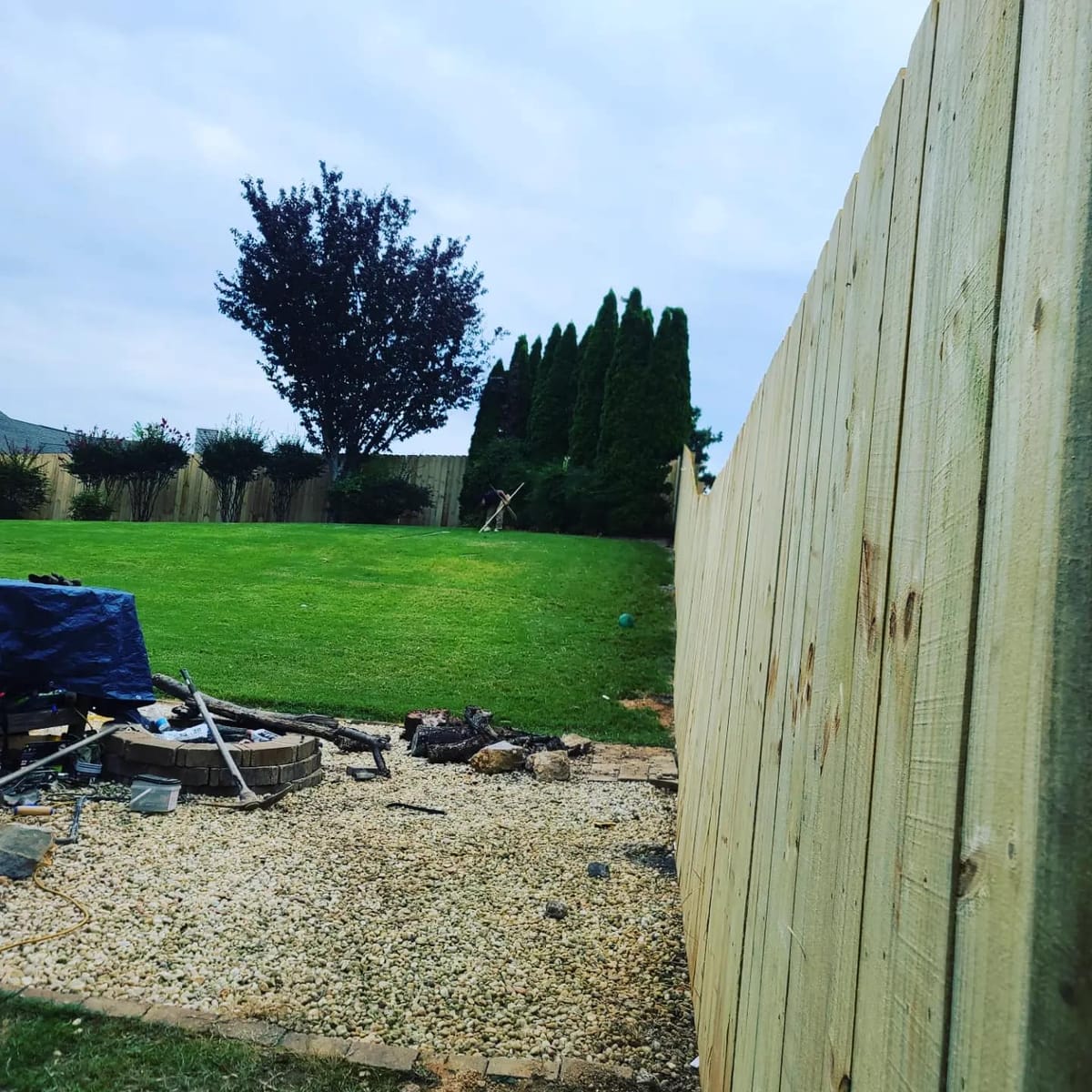
The posts moved. Not the panels, not the fasteners, not the material. In almost every leaning fence anybody has ever looked at, something happened below ground and the visible part followed it.
Georgia clay makes that easy. It swells when it's wet and pulls away from itself when it dries.
A post that's not deep enough gets lifted a little every wet season and left loose every dry one. So depth and setting aren't a detail. They're the fence.
Line posts hold up panels. Corner posts and end posts hold up the idea of a straight line.
Every change of direction is a point where the fence pulls two ways at once. Every termination is a point where it pulls one way and has nothing on the other side. Those posts go deeper and take more concrete, because everything between them is only as square as they are.
Get the corners right and the rest of the run is arithmetic. Get them wrong and no amount of care in the middle rescues it.
Post spacing is set by what's going between the posts. Panels want a spacing that matches their width, so you're not cutting one down in every bay. Woven and stretched materials want a spacing that keeps tension even.
Either way it has to be consistent, because the eye reads a fence end to end. A single short bay at the end of a long run is the thing visitors notice from the driveway.
Very few yards around here are level. A fence has two honest answers to a slope.
Racked, where the panel skews so the top follows the ground and the bottom stays tight to it. That holds animals and looks continuous, and not every material will do it. Stepped, where each section stays level and drops at the post.
That looks deliberate and formal, and it leaves triangles of daylight under each section that a determined dog will find. Neither is better. They suit different yards, and the choice belongs to you, not to whoever is holding the shovel.
A fence gets looked at. A gate gets swung, leaned on, slammed and dragged, several times a day, for years.
All of that arrives at two hinge points on one post. That post takes more load in a week than a line post takes in a decade. So it goes in deeper and heavier, and the fence is laid out around it, not the other way around. Then the hardware has to suit the use.
A gate you go through daily wants a latch you can work with one hand and a full bin of recycling in the other. A double gate you open twice a year wants a drop rod that will still find its hole after a summer of settling.
Everything above is true whatever the fence is made of. What each material asks of you afterward is very different, and those are separate pages.
Privacy and wood fence covers board patterns, species and why a wood fence leans. Chain link is the tension system and where it wins. Vinyl and aluminum covers the no-refinishing argument and where each one fails.
An existing fence that has started to go belongs on fence repair and gates.
Before you call anyone: how to read a fence quote shows what moves a fence price and what a quote should itemize, privacy fence ideas and styles shows what each pattern looks like, and wood fence maintenance covers post depth and why posts rot. Finished work is in the gallery.
Our work
White vinyl privacy fence with braced gate, enclosing a wooded rear garden, Dalton, Georgia
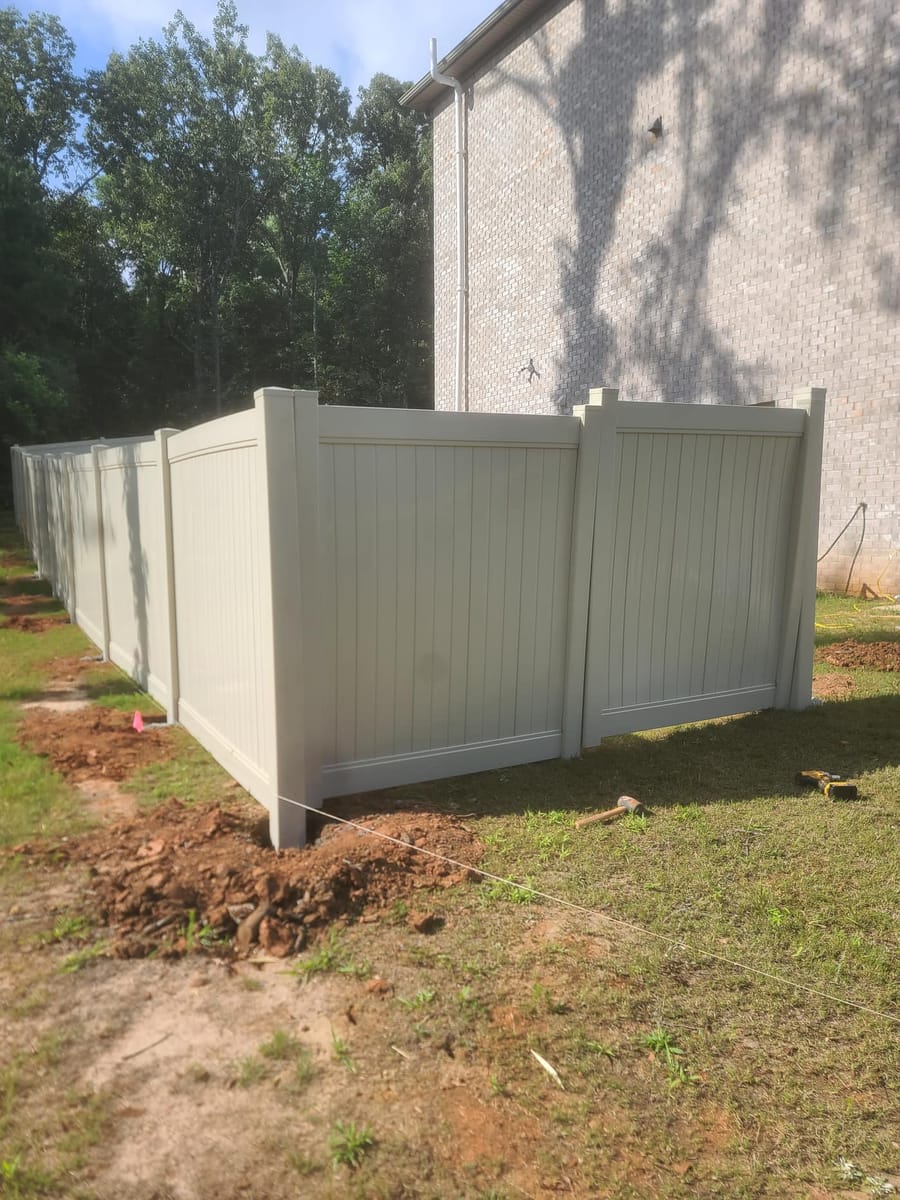
Tan vinyl privacy fence installed across a wooded residential boundary, Stockbridge, Georgia
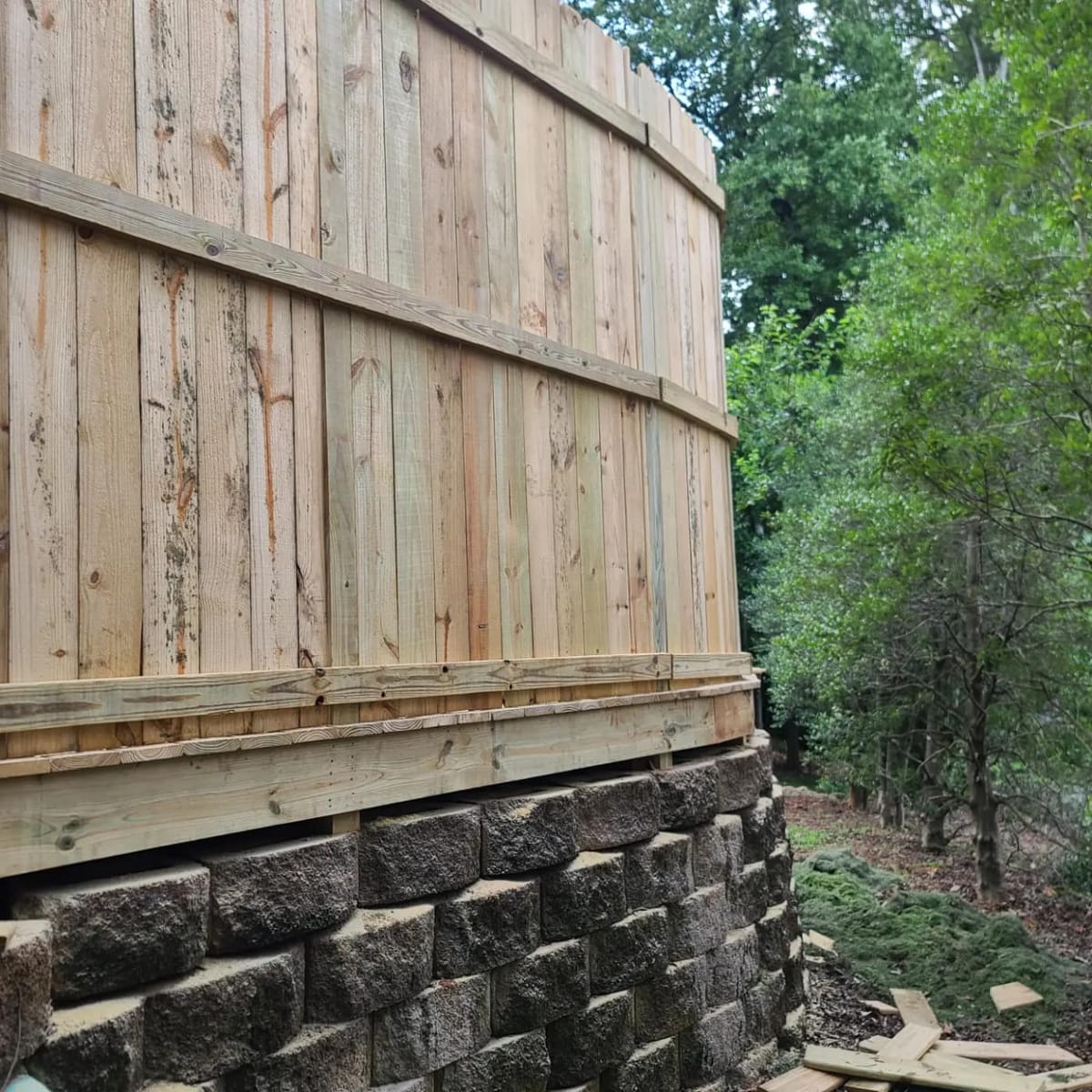
Wooden privacy fence sitting on top of the block wall, Atlanta, Georgia
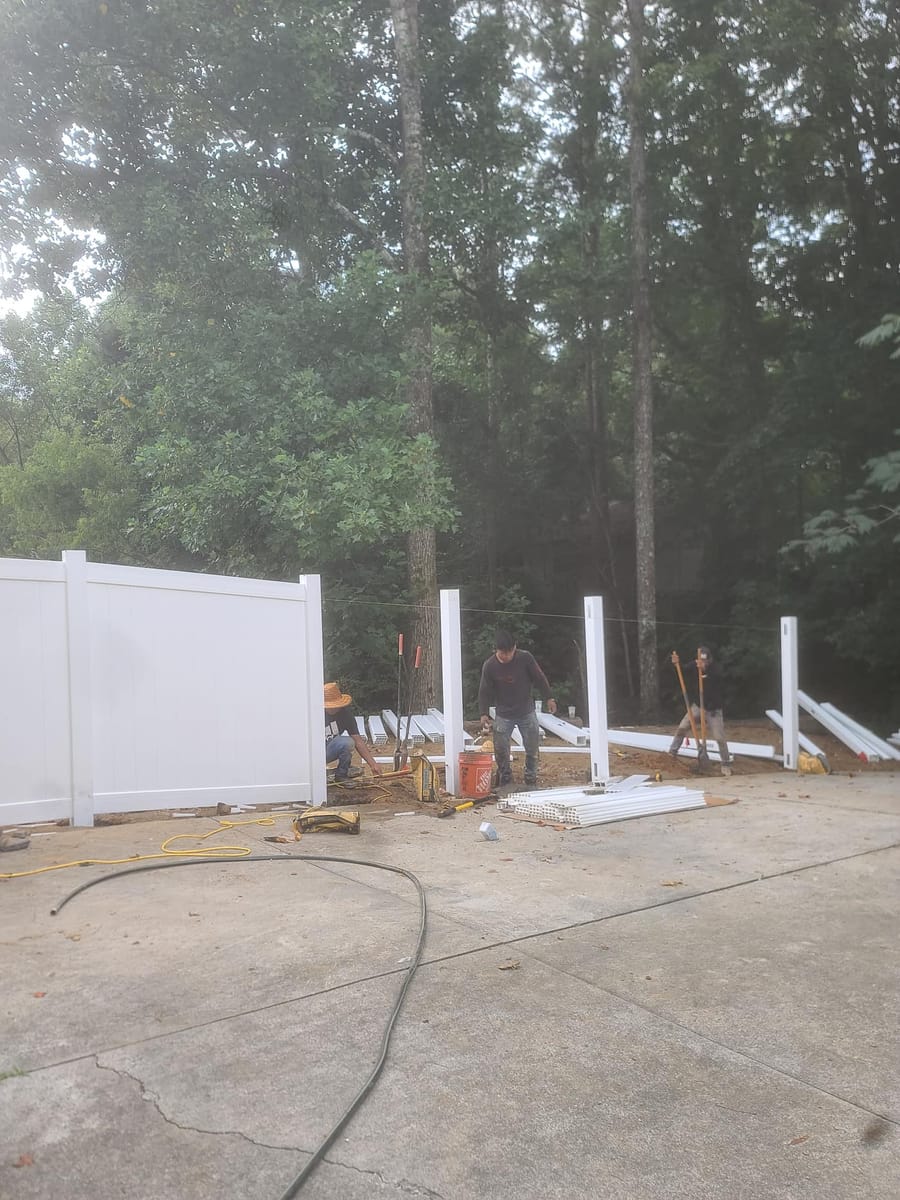
White vinyl privacy fence with braced gate, enclosing a wooded rear garden, Dalton, Georgia
Three quick steps. We call you back ourselves, and nothing here commits you to anything.
We call back ourselves, so the number that rings you will be (706) 879-8873. If you would rather not wait, call us now at (706) 879-8873.
Got a photo of the spot? Text it to (706) 879-8873. It answers more than a paragraph does, and it reaches the same phone as your request.
What actually happens
Before a single hole is dug, we walk the run with you and mark it. Where the fence goes and where the gates want to be are the two decisions that are expensive to change afterward and free to change now.
Corner and end posts carry the whole run. They go in first, get set deeper and heavier than the posts between them, and everything else is lined off them.
A string pulled between the ends is what keeps a long run straight over a rise. Eyeing a fence across uneven ground gives you a fence that wanders, and it only becomes obvious once the panels are on.
On a slope a fence either racks to follow the ground or steps down in level sections with gaps underneath. Which one suits your yard is decided on site, because it changes both the look and how well it holds a dog.
Gates go on after the run is set so the opening is measured, not assumed. Hinges, latch, drop rod and swing direction all get settled with you standing at the gate.
Questions we get asked
Most residential runs go in over a couple of days, with a wait between setting posts and hanging panels so the concrete can take up. Longer runs, heavy slopes and rocky ground add time. You get the schedule with the quote, not after work starts.
Yes. Pulling the old run, digging the old footings out and hauling the material off is part of the job and it's priced in, not left as a surprise line.
It depends what the fence is for. Privacy, containing a dog, marking an edge and keeping a pool safe are four different problems. We fit wood, chain link, vinyl and aluminum, so the recommendation isn't driven by what we happen to stock.
Yes. A single side, a gap between two neighbors' existing fences, or a small enclosure around a yard for a dog are all normal jobs.
Wide enough for whatever has to get through it. A mower needs more than a person, a trailer or a truck needs much more, and a gate that turns out to be too narrow is the one thing you notice every week. It's worth measuring the widest thing you own.
We measure the run on site instead of off a satellite image. Twenty eight reviews, all five stars.