
Fencing
Wood Fence Maintenance
A wood fence has one clock on it, and it runs at the ground line. Everything below is either about slowing that clock down or about what to do once it has run out.
Updated August 2026
Staining a fence: the timing question
The most common question about a new fence is when it can be finished, and the usual advice, a year, is wrong in both directions.
What matters is whether the wood will take the finish in. Pressure treated lumber is usually delivered wet from the treatment process, and finish applied to a wet board sits on the surface and peels later.
Test it. Drop a spoonful of water on a picket. If it beads and sits there, wait. If it soaks in within a minute, the fence is ready.
In this climate, on a fence that has had a few weeks of dry weather, that's often sooner than people expect. Do the test on a board on the shaded side too, because that side dries last.
Cleaning first
Even a new fence has mill glaze, dust and handling marks on it. An older fence has mildew and a gray surface layer.
A wood cleaner followed by a brightener does both jobs, the same sequence used on a deck floor but far less arduous, because a fence is vertical and doesn't hold the cleaner. Rinse thoroughly and let it dry a full day before finishing.
Go gently with a pressure washer. Fence pickets are thinner than deck boards and a narrow tip will carve grooves into the soft grain in seconds. Wide fan, low pressure, kept moving, or better, a brush and a chemical cleaner.
Which finish for a fence
A fence is a much easier surface than a deck. It sheds water instead of holding it and nothing walks on it, so finishes last considerably longer here.
- Semi-transparent stain is the sensible default. It keeps the grain, protects against UV and fails gracefully by going thin, not peeling.
- Solid stain covers the grain and lasts longer, and when it does eventually fail it lifts off, which means stripping.
- Paint looks superb on a picket fence and commits you to repainting it forever.
- Clear sealer slows water absorption and does nothing about UV, so the fence still goes gray. Choose it only if gray is what you want.
Spray and back-brush is the fast method and the brush isn't optional: spraying alone lays finish on the surface without working it into the grain. Do the fence before the planting goes in, if you have any say in the order.
How often
Most semi-transparent finishes on a Georgia fence want attention every three to five years, and the south and west faces go first because that's where the sun is. It's normal for one side of a fence to need recoating while the other still looks fine.
Wash the fence yearly regardless. On the shaded side, green algae grows on almost everything here, and it holds moisture against the wood.
Post depth: what we set to
This is the number that decides whether the fence is still straight in year twelve.
We set a line post about a third of its standing height into the ground. On a six foot fence that means an eight foot post with roughly two feet below grade. Corner posts, end posts and gate posts go deeper, because those are the ones taking a pull, not just standing there.
Why a third, in one sentence: a fence post is a lever with the wind on the long end, and the buried portion is what resists that lever. Shorter buried lengths don't fail immediately. They fail in a storm four years later, all along the run, at the same time.
The hole matters as much as the depth. A hole about three times the width of the post gives the concrete enough shoulder to work against the soil. A narrow hole with a post rattling in the middle of it is depth without leverage.
How much concrete per post
Straight arithmetic, so you can check a material list.
A ten inch hole, two feet deep, with a 4x4 post standing in it, holds a little under one cubic foot of concrete. A fifty pound bag of mix makes roughly a third of a cubic foot. So budget two to three bags per line post.
A gate post in a twelve inch hole three feet deep takes four to five bags, and it's worth every one of them, because gate posts are where fences fail first.
Two habits that cost nothing:
- Crown the top of the collar. Slope the concrete away from the post so water runs off instead of pooling in a ring around the wood.
- Put gravel in the bottom of the hole. A few inches of crushed stone under the post gives water somewhere to go instead of sitting in a concrete cup.
Post spacing
Six to eight feet between posts is the normal residential range for a vertical board fence, and that's because rail stock comes in those lengths and because a rail spanning further starts to sag under the weight of the pickets.
Two situations pull it in. Horizontal designs, where the boards themselves do the spanning rather than sitting on rails, want the posts closer. And any fence on an exposed windward boundary benefits from shorter spans, because the load per post drops.
Panel systems in vinyl and aluminum take this decision away from you entirely: the panel length sets the spacing and there's nothing to adjust.
Why posts rot at the ground line, and what actually helps
A buried post isn't rotting from the bottom. It rots in a narrow band right at the soil surface, and there's a reason for that.
Rot needs moisture and oxygen together. Deep in the ground there's water but very little air. Above the ground the wood dries out between rains. At the boundary, the wood is wet and the air is plentiful, and that's where fungus does its work.
What genuinely slows it:
- Concrete crowned to shed water, not dished to hold it.
- Gravel under the post so it's not standing in a puddle.
- Keeping mulch, soil and beds pulled back from the base. Every inch of mulch banked against a post is an inch of new ground line.
- A kickboard along the bottom of the fence so the pickets aren't in contact with the dirt.
- Not paving right up to the fence line. Runoff off a slab or a patio lands exactly where the posts are.
- Keeping sprinkler heads pointed away from the fence, which is a surprisingly common cause.
Small repairs worth doing yourself
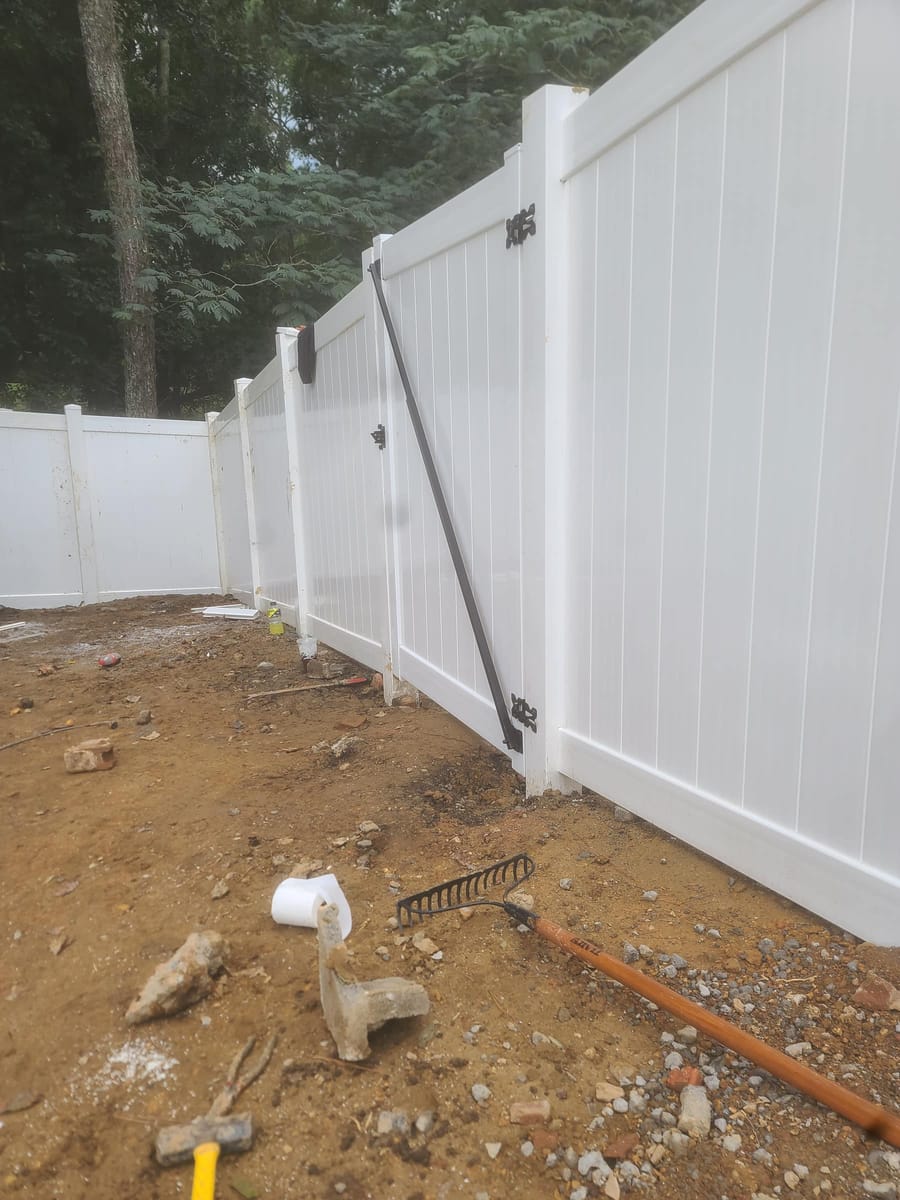
A sagging gate. Nine times out of ten the gate hasn't failed. The hinge post has leaned.
If the post is solid, an anti-sag cable and turnbuckle across the gate frame, running from the top hinge corner down to the bottom latch corner, will pull it square in ten minutes. If the post itself has moved, the cable won't save it.
A loose picket. Refasten into fresh wood, not the old hole, and use a fastener that suits treated lumber, or you get a black streak down the board within a year.
A cracked rail. A sistered piece alongside the rail is a legitimate repair and holds perfectly well behind pickets.
A post that has gone at grade. This isn't a homeowner repair. The options are a new post or a steel or concrete spur bolted alongside, and both mean taking the fence apart at that bay. That work is here.
Repair or replace
The test takes one minute. Walk the fence and push firmly on each post at the ground line. Then push a screwdriver into the wood at that band.
If the posts stand firm and the screwdriver doesn't sink, the fence has life in it. Boards, rails and gates are all replaceable and the fence goes back to normal.
If most posts move or the wood is soft, you're looking at a rebuild.
Putting new boards on old posts in that state is spending most of the money for a fraction of the life, and it's the most common way people pay for a fence twice. What drives a replacement quote covers what happens next.
Vinyl and chain link, briefly
Vinyl needs no finish and does need washing, because green growth appears on the shaded side of everything in this climate. Soap, water and a soft brush. Avoid abrasive pads, which dull the surface permanently.
Chain link is mostly maintenance free. What does need attention is tension: a fabric that has gone slack can usually be re-tensioned at the terminal posts, not replaced, and a bent top rail can be swapped section by section. The chain link page covers how the tension system works.
Where we work
We repair and rebuild fence across northwest Georgia and the north Atlanta metro, including Calhoun and Dallas, and the town pages for Calhoun and Dallas cover what the lots in each place usually mean for a fence line.
If you're rebuilding instead of repairing, the style guide is worth reading before you choose, because the style decides the post spacing. Send a photo down the fence line for a straight answer on whether yours is worth saving. We'll tell you if it's not.
Want a straight answer for your own yard? Call (706) 879-8873 and talk it through with Hervin Ramirez, or send the details over and we will call you back.
Our work
Our completed work
Common questions
Questions people ask about this
How deep should fence posts be?
We set a line post about a third of its standing height into the ground, so a six foot fence gets roughly two feet below grade in an eight foot post. Gate posts and corner posts go deeper, because they carry leverage that line posts never see.
How much concrete does one fence post take?
For a line post in a ten inch hole about two feet deep, budget two to three fifty pound bags. A gate post in a wider, deeper hole takes four or five. Mix it stiff and crown the top so water runs off the collar instead of sitting on it.
When can you stain a brand new fence?
When the boards will absorb water instead of beading it. Treated lumber usually arrives wet, and putting finish on wet wood traps the moisture. A few weeks of dry weather is common. Test with a spoonful of water, not a date.
Why do fence posts rot right at the ground?
That inch above and below the soil line is the only part of the post that's wet and full of air at the same time. Below it there's less oxygen, above it the wood dries. Everything that slows rot is about keeping that band drier.
Is my leaning fence worth repairing?
If a few posts have gone and the rest are solid, yes, and it's much cheaper than a new fence. If most of the posts are soft at grade, new boards on old posts is money spent twice.