
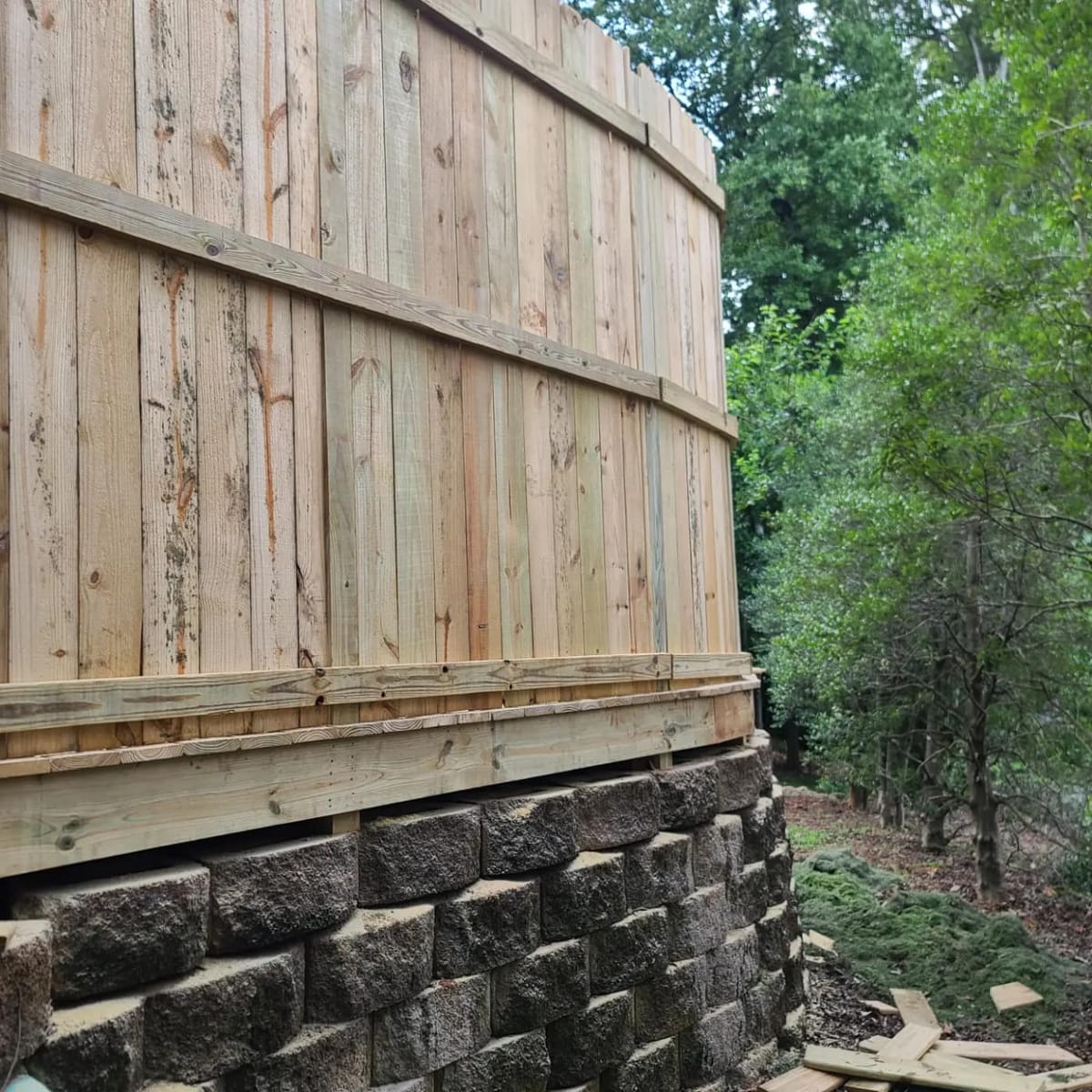
Wooden privacy fence sitting on top of the block wall, Atlanta, Georgia
Wood, and what it does over time
Wood is the only fence material that is still alive when you buy it. Everything about building with it follows from that.
Northwest Georgia and the north Atlanta metro
Dig out a failed post and the damage is almost never at the bottom. It is a band a few inches either side of ground level. Below that the wood is starved of air. Above it the wood dries out.
In between it gets both, over and over, and that is the condition rot needs. Two things change how long that band takes to eat through a post.
One is the treatment in the wood, which is not a single grade. Lumber rated for above-ground use and lumber rated for ground contact hold different amounts of preservative. The other is whether water is invited to sit there. A concrete collar sloped away from the post sheds.
A collar with a saucer on top holds a puddle against the grain every time it rains.
This is what separates a privacy fence from an open one. Chain link and split rail let wind through. A board on board fence does not.
Every gust that hits it is caught by the whole surface and delivered to the posts as a twisting load. Which is why a privacy fence needs more post and more concrete than an open fence of the same height.
The pattern you pick therefore has a structural cost, not only a look. Shadowbox breathes. Solid does not.
Boards do not hold themselves up. Rails do. Two rails, one high and one low, work fine on a short fence. Push the height up and the middle of every board has nothing behind it.
The boards cup outward and the top line of the fence goes wavy. A third rail through the middle fixes that for the cost of one more piece of lumber per bay.
It is the cheapest upgrade on any tall wood fence, and the first thing left off a fence built to a number.
Stockade sets boards edge to edge on one side of the rails. It is the fastest and least expensive, it gives full privacy on day one, and as the boards dry and shrink you get thin gaps between them. Board on board overlaps every board onto the one beside it.
The overlap absorbs that shrinkage, so it is still solid in year five. It uses noticeably more lumber.
Shadowbox alternates boards front and back. From straight on it reads as solid. From an angle you see through it. Air passes rather than pushing, and both neighbors get the identical fence.
Field fence changes the arithmetic rather than the principles. Posts go further apart, the material between them is lighter, and everything depends on the corners.
A long wire run is under constant tension, and all of it pulls the corner posts inward. Braced corner assemblies resist that. Skip the brace and the corner leans in over a season, taking the tension out of the whole line.
Layout, post setting and gates in general are on the fence company page, which is the place to start if you have not chosen a material yet.
If you would rather never refinish anything, vinyl and aluminum is the honest comparison. If the fence is about containment rather than looks, chain link costs less and lasts a long time. An existing wood fence that has started to lean belongs on fence repair and gates.
For what the finished thing looks like, privacy fence ideas and styles pairs each pattern with what it costs in framing. Post depth, concrete per post and why posts rot are worked through in wood fence maintenance and repair, and how to read a fence quote shows what moves the price.
Our work
Wooden privacy fence sitting on top of the block wall, Atlanta, Georgia
Three quick steps. We call you back ourselves, and nothing here commits you to anything.
We call back ourselves, so the number that rings you will be (706) 879-8873. If you would rather not wait, call us now at (706) 879-8873.
Got a photo of the spot? Text it to (706) 879-8873. It answers more than a paragraph does, and it reaches the same phone as your request.
What actually happens
A solid privacy panel is a wall. Wind pushes on the whole of it and the load arrives at the posts, so heavier posts and more concrete are worth more here than on any open fence.
A footing crowned above grade sends rain away from the post. A footing dished below it holds a ring of water against the wood, which is the fastest way to lose a post that was otherwise fine.
Two rails hold a short fence. A tall privacy fence with two rails bows in the middle within a couple of summers, because there is nothing supporting the center of every board.
A gap at the bottom keeps end grain out of the mulch and the wet leaves. Boards resting on soil wick water up into themselves and rot from the bottom edge inward.
Board on board, shadowbox and stockade give different amounts of privacy, different airflow and a different face to your neighbor. We walk through what each one will look like from your side before anything is cut.
Questions we get asked
Treated pine is what most privacy fence around here is built from and it is the value answer. Cedar moves less, stays straighter and holds its color longer before it silvers, and it costs more. Both work. They ask different amounts of you afterward.
Shadowbox alternates boards on either side of the rails, so both neighbors get the same view and air moves through the gaps. Board on board overlaps boards on one side, so it is solid, gives full privacy and catches more wind.
Look at where the old posts failed. Almost always it is a band right at ground level, where the wood was wet often and dry often. Posts rated for ground contact, a crowned footing and boards kept off the dirt are what change that outcome.
Yes. Split rail, four board and woven wire on a wood frame are the same post problem at a longer spacing, and long runs across acreage need the corner and brace assemblies to be right or the whole line pulls in.
It is a courtesy rather than a rule, and shadowbox sidesteps the question entirely by looking the same from both directions. Say which side you care about before the boards go on and you will get what you wanted.
Where we work
Give us the rough length, the height you have in mind and how many gates. That is enough to start.