
Fencing
How to Read a Fence Quote
Fence quotes for the same yard routinely differ by a factor of two. Almost none of that gap is profit. It's gates, posts, terrain and what happens to the old fence.
Updated August 2026
Getting a real number
If you want a real figure for a real fence, we'll give you one. We work out of Adairsville and quote across northwest Georgia and the north Atlanta metro, and a photo and a rough length is all we need to start.
What follows is the list of things that actually move a fence quote, in rough order of how much they move it, so you can look at two prices and see what the second one included that the first one didn't.
How fence pricing works
Fences are priced by the running foot, plus each gate as a separate item, plus mobilization for getting a crew and a machine to your property at all.
That third piece is why a very short fence rarely costs a third of a fence three times its length. The truck, the auger and the crew day are the same either way.
The running foot figure itself bundles together material, post holes, concrete, hardware and labor. Which means two contractors can quote the same number per foot and be describing very different fences, because post spacing and post depth are inside that number and neither one is visible in the total.
The materials, ranked
Least expensive installed to most, for a comparable height on comparable ground.
- Galvanized chain link. The cheapest fence that lasts. Nothing else in this list competes on installed cost.
- Vinyl-coated chain link. A modest step up, and the coating buys a fence that fades into the yard and doesn't catch the sun.
- Pressure treated wood, dog-ear picket. The volume seller in residential Georgia.
- Pressure treated wood, privacy at six feet. More boards, heavier posts, more of everything.
- Board on board or shadowbox. Meaningfully more material than a flat privacy fence for the same run length, because the boards overlap.
- Aluminum. Ornamental panels, priced per section, and the sections don't care that your yard isn't flat, which costs money on a slope.
- Vinyl privacy. Usually the most expensive of the common residential options up front, and the only one that never needs a finish.
- Cedar, horizontal designs, custom gates. Anything in this band is priced as a carpentry job, not as a fence.
What that ranking doesn't show is life. A galvanized chain link fence and a pressure treated privacy fence installed on the same day won't reach the same age. There's more on how each material behaves in the material comparison.
The eight things that move the number
Roughly in order of impact.
1. Gates
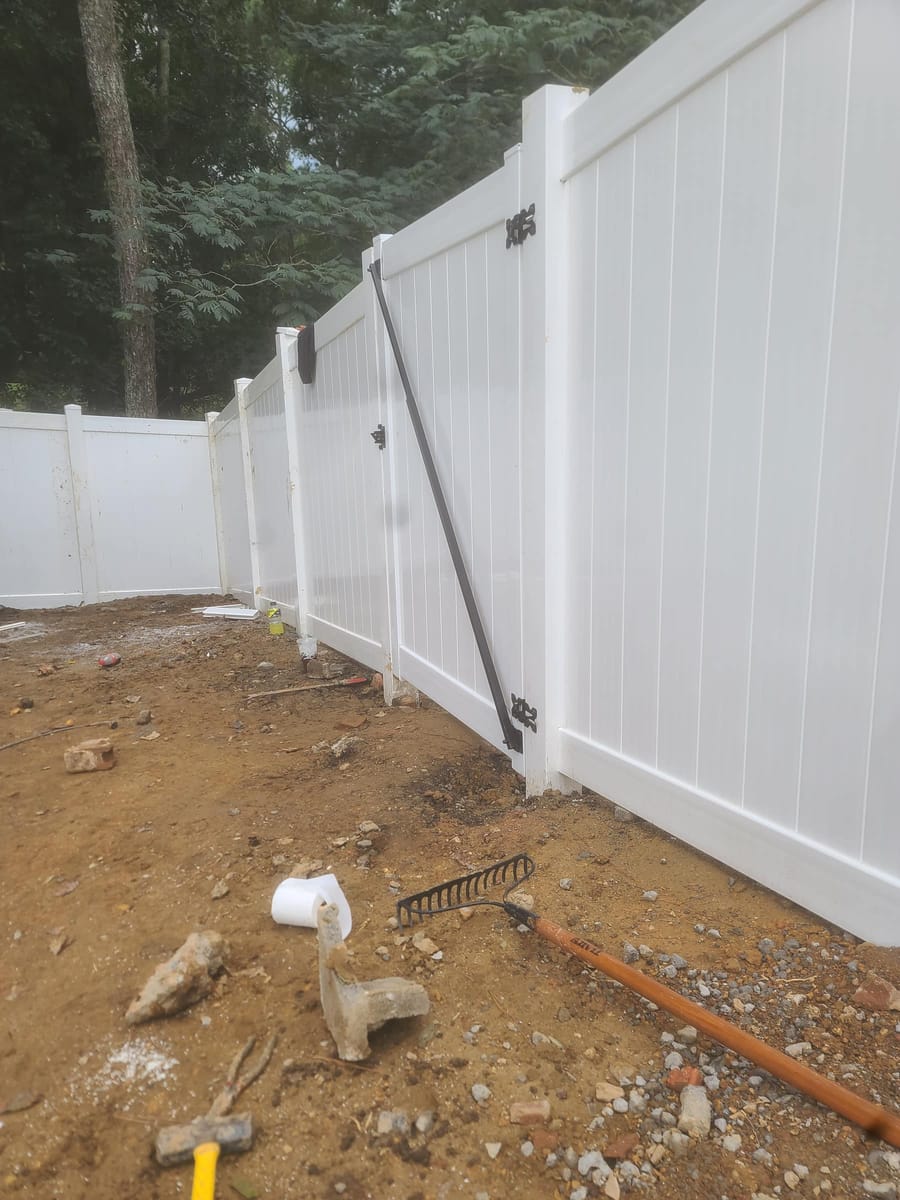
A gate isn't a section of fence with hinges. It's two heavier posts set deeper, a braced frame, a diagonal to stop it dropping, and hardware that has to survive being pulled on daily.
A drive gate is all of that at double the width, where the leverage on the hinge post roughly quadruples.
Adding two walk gates and a drive gate to a modest fence can move the total more than upgrading the entire material. It's the most common place a cheap quote is cheap.
2. Post spacing and post depth
The invisible half of a fence. Posts set closer together and deeper cost more in holes, concrete and labor, and they're why one fence is still straight in year twelve and the one across the street isn't.
This is the number to ask about, and the maintenance guide covers what happens when it's skimped.
3. Removing the old fence
Taking down and hauling away an existing fence is real labor and real disposal. Old posts set in concrete are the worst of it, because every one is a hole to dig twice.
Some quotes include it. Some assume the yard is clear. Check.
4. Terrain
A fence on a slope is either racked, so the panels follow the ground, or stepped, so each section stays level and the gaps go underneath.
Racking is more work on wood and impossible on some panel systems. Stepping leaves gaps that then need filling, which on a walled or terraced yard can turn into a second small project.
5. What's in the ground
Red clay augers beautifully. Rock doesn't. A line that hits rock partway along turns a fast day into a slow one, and no quote can promise what's under a lawn until a hole goes in.
6. Access
If the auger can drive to the fence line, holes take minutes. If material has to be carried through a house or around a block, the same fence costs materially more. Corner lots and open side yards are cheap. Landlocked back gardens aren't.
7. Height
Going from four feet to six isn't a fifty percent increase in material. It's more boards, longer posts, deeper holes and heavier hardware, and it changes what the wind does to the fence, which changes what the posts have to be.
8. Length, in the direction you wouldn't guess
Cost per foot falls as the run gets longer, because mobilization spreads out. A very short fence carries the whole setup cost on very few feet.
What's different about each material
Chain link. The price levers are height, mesh size, wire gauge, whether it's galvanized or vinyl-coated, and whether the top is finished with a rail or a tension wire. A top rail costs more and produces a much stiffer fence.
Terminal posts, the corner and end posts that take the tension, are heavier and more expensive than line posts, so a yard with many corners costs more than a straight run of the same length. That's all covered on the chain link page.
Wood. Post size and grade, rail count, picket grade and whether the pickets are attached to two rails or three. Three rails on a six foot fence is the difference between boards that stay flat and boards that cup. See wood fence construction.
Vinyl and aluminum. Priced by the section, so the post spacing is fixed by the manufacturer and can't be adjusted to suit your yard. Odd lengths mean cut sections, and slopes mean either stepping or ordering rackable panels. The trade-offs are here.
Repair against replacement
The economics are simple and they hinge on one thing: are the posts sound.
If the posts are solid and the failure is boards, rails, a sagging gate or a section a tree came down on, repair is far cheaper and the fence goes back to a normal life.
If the posts have rotted at the ground line, you're being asked to buy new boards on old posts. That fence fails again in the same place, and the second visit costs what the first one saved.
What a quote should itemize
Ask for these six lines. A contractor who can answer them quickly is describing a real fence.
- Total running feet, and how it was measured.
- Post spacing and post depth.
- Number of gates, their widths, and the hardware included.
- Whether removal and disposal of the existing fence is in or out.
- How slopes will be handled, racked or stepped.
- What's warranted, by whom, and for how long.
Then compare. Two numbers that looked far apart usually converge once both quotes describe the same six lines, and when they don't converge, you can see exactly where the money went.
Getting a real figure
Twenty eight reviews sit on our Google profile, and all of them rate the work five stars.
We quote fencing everywhere we work, including Marietta, Kennesaw and Rome, and the town pages for Marietta and Kennesaw cover what the lot pattern in each place usually means for run length and gate count.
If you already know the style you want, the style guide covers what each one asks of the frame. Send the length and a photo when you're ready for a number.
Want a straight answer for your own yard? Call (706) 879-8873 and talk it through with Hervin Ramirez, or send the details over and we will call you back.
Our work
Our completed work
Common questions
Questions people ask about this
Why do fence quotes vary so much for the same yard?
Gate count, post spacing, post depth, whether the old fence is removed, and whether the ground can be dug or has to be worked around. Two quotes that look like the same fence often describe four different amounts of work.
What's the cheapest fence that lasts?
Galvanized chain link, by a distance. It's the least expensive material to install and the longest lived of the low-cost options, which is exactly why it's still everywhere fifty years after it went in.
Is vinyl cheaper than wood in the long run?
It can be, because vinyl isn't stained and wood is. The comparison turns on how long you keep the house and whether you would actually have stained the wood.
How much does a gate add?
More than people expect. A gate is heavier posts, hardware, bracing and a diagonal, and a double drive gate is the single most underestimated line on most fence quotes.
Is it cheaper to repair a fence than replace it?
Almost always, if the posts are sound. If the posts are the thing that failed, repair is usually money spent on a fence that will fail again in the same place.