
Choosing
Types of Fences and Decking
Every outdoor project starts with the same four arguments: which fence, which decking, deck or patio, and porch or sunroom. Here they are, side by side, with the part people find out too late.
Updated August 2026
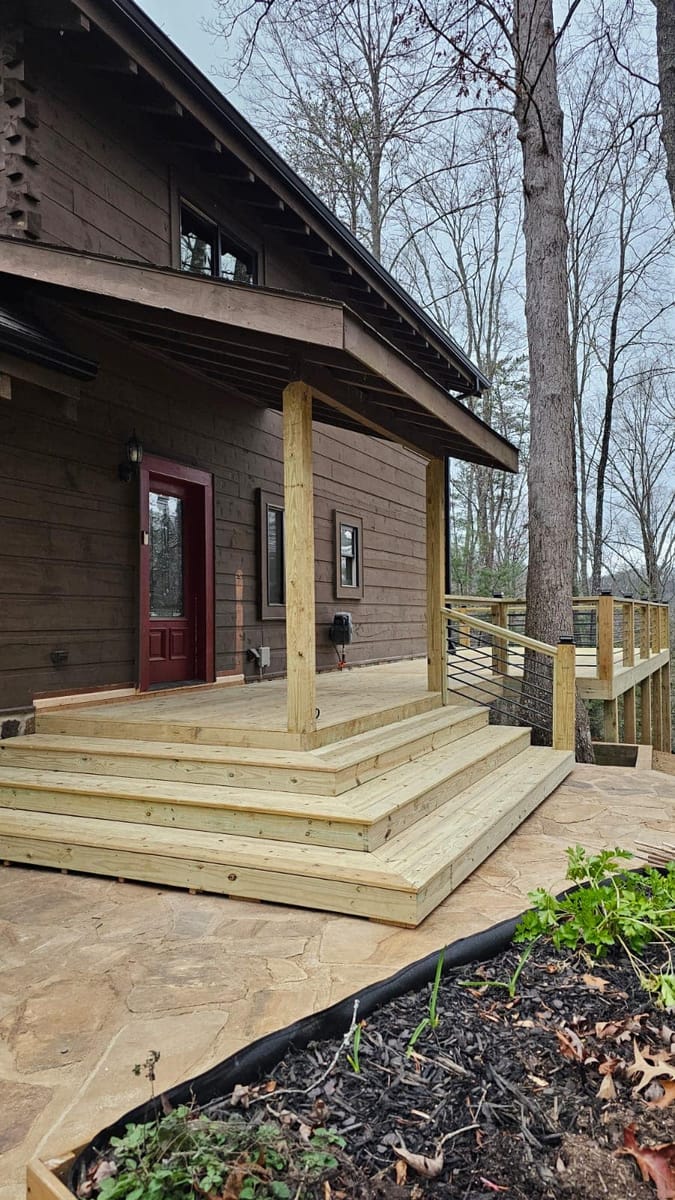
Which one are you stuck on
Four decisions, each with its own table. Skip ahead to yours.
We install all of these options, which matters mostly because there's no product line to defend. A fence company that only sells vinyl will always find a reason for vinyl.
Types of fence
| Type | What it's for | Privacy | Upkeep | Watch out for |
|---|---|---|---|---|
| Chain link | Containment at the lowest cost, over any distance | None | Almost none | Corner posts take the tension, so a yard with many corners costs more |
| Wood picket | Boundary and looks, front yards, pets | Partial | Wash and coat | Short pickets don't contain a jumper |
| Wood privacy | Screening, at full height | Full | Wash and coat | Takes wind like a sail, so posts are the whole story |
| Board on board | Privacy with no gaps as the wood shrinks | Full, permanently | Wash and coat | Noticeably more board per running foot |
| Shadowbox | Privacy that looks the same from both sides and lets wind through | High at an angle, partial straight on | Wash and coat | Neighbors see through it when standing square to it |
| Horizontal slat | Modern appearance, light through the gaps | Adjustable by gap | Wash and coat | Needs closer posts, because the boards span between them |
| Vinyl privacy | Full screening with no finishing, ever | Full | Wash occasionally | Panel sizes are fixed, so slopes and odd lengths cost more |
| Ornamental aluminum | Pools, front yards, keeping the view | None | None | Sections don't rack far, so steep ground is stepped |
| Split or ranch rail | Marking acreage, rustic frontage | None | Low | Contains nothing on its own without mesh added |
Wood or vinyl
This one is decided by how long you intend to stay.
Vinyl costs more on day one and asks for nothing afterward. Wood costs less and wants washing and re-coating on a rhythm. Across a short ownership, wood is cheaper. Held long enough, and if you would genuinely have kept up the finishing, vinyl closes the gap and passes it.
Two things people get wrong. Vinyl isn't maintenance free, it's finish free: it still gets green on the shaded side and still needs washing. And wood is repairable board by board, while a damaged vinyl panel is a panel replacement. Both materials are covered here, and what the wood upkeep actually involves is in the fence maintenance guide.
Best fence for privacy, and best fence for dogs
Privacy. Board on board holds full privacy permanently, because the overlap absorbs the shrinkage that opens gaps in a flat privacy fence. If you want privacy and airflow, shadowbox. If you want privacy and light, a horizontal design with a deliberate gap.
Dogs. The material barely matters. What matters is height for a jumper, the gap at grade for a digger, and sightlines for a barker, since a dog that can see the street will bark at the street.
A solid fence is calmer for a reactive dog than a chain link one, whatever it's made of. Wood construction detail is here, and the style guide covers how each pattern looks.
Decking materials
| Material | Up front | Maintenance | How it fails | Heat underfoot |
|---|---|---|---|---|
| Pressure treated pine | Lowest | Clean and re-coat every few years | Splits, cups, fastener stains | Moderate |
| Cedar | Middle | Clean and re-coat, less movement | Weathers gray, softens at contact points | Moderate |
| Uncapped composite | Middle | Wash | Fades, stains, holds mold in the texture | Warm |
| Capped composite | Higher | Wash | Scratches in the cap, color is permanent | Warm to hot in dark colors |
| PVC | Highest | Wash | Expands and contracts more, so fastening is exacting | Coolest of the synthetics |
The honest composite argument
Composite isn't a maintenance-free deck. It's a no-finishing deck. It still needs sweeping and washing, and in shade it grows the same black spotting as anything else.
What you're buying is the removal of a recurring weekend and a recurring purchase. Over a long ownership that's a real saving in effort, and for many people that's worth more than the money.
What you're giving up: the ability to sand out a damage mark, and some heat comfort in dark colors beside a pool. Also note that composite is a decking material only.
The frame underneath is still wood, and it's still the part that decides how long the deck lasts. More on the tiers here, and the sizing calculator will tell you how many boards either choice needs.
Deck, patio or porch
These three words get used interchangeably and they're three different structures.
| Deck | Patio | Porch | |
|---|---|---|---|
| Sits on | A frame and posts | The ground | A frame or a slab, attached to the house |
| Made of | Wood or composite boards | Pavers, concrete or stone | Either, with a roof |
| Handles a slope | Very well | Poorly without a wall | Depends what's under it |
| Shade and rain | Neither, unless covered | Neither, unless covered | Both, by definition |
| Maintenance | Boards and finish | Joints, weeds, occasional resetting | Roof, floor and screen |
| Best when | The ground falls away from the door | The ground is near door level | You want to be outside in weather |
The practical rule: measure the drop from your back door to the ground where you want to sit. A small drop favors a patio. A large one favors a deck, because filling and holding that much ground costs more than framing over it.
Screened porch or sunroom
A screened porch is an outdoor room with the insects removed. Air moves through it, it's the temperature of outside, and it's wonderful for most of the Georgia year.
A sunroom is an indoor room with a lot of glass. It works in January, it's quiet, and it changes how your house heats and cools.
People who ask for a sunroom often want a screened porch, because what they're picturing is sitting outside without bugs.
People who ask for a screened porch and then say "and we would use it in winter" want a sunroom. The enclosure page covers what each one involves, and the layout ideas are in the porch ideas guide.
Pavers or poured concrete
One consideration outranks all the others in this part of Georgia: the clay moves.
A paver field is thousands of small pieces on a flexible base. When the ground shifts, the field shifts with it, and a settled patch can be lifted and reset by hand.
A slab is one piece. When the ground shifts under a slab, the slab cracks, and the crack is permanent. Control joints decide where it cracks, which is a design choice worth making deliberately.
Against that, concrete is faster to place and cheaper per square foot for a large simple area, and a broom finished slab under a roof will outlive everyone.
The choice is really about how much ground movement the site has and how much the appearance of a crack would bother you. What separates the two on price goes further.
A short decision path
- Do you need to be dry out there? If yes, you're looking at a porch or a solid cover, not a pergola.
- Does the ground fall away from the door? More than a couple of steps means deck. Less means patio.
- Will you re-coat wood every few years, honestly? If no, buy composite decking and vinyl fencing, or accept that the wood will go gray.
- Is the fence for containment, screening or appearance? Those three answers point at three different fences and there's no single best one.
- Is anything about the yard steep or wet? Then the ground work comes first and the material choice second.
Then get a real recommendation
We build decks, fencing, pergolas, porches, retaining walls, patios and fire pits, which means the recommendation you get isn't a product line in disguise. We work out of Adairsville, covering Woodstock, Dallas and the rest of northwest Georgia and the north Atlanta metro.
Twenty eight reviews sit on our Google profile, and all of them are five stars. Describe the yard and we'll tell you which of these arguments actually applies to it. If money is the sticking point, what drives a fence quote is the most useful next page. Otherwise get in touch here.
Want a straight answer for your own yard? Call (706) 879-8873 and talk it through with Hervin Ramirez, or send the details over and we will call you back.
Our work
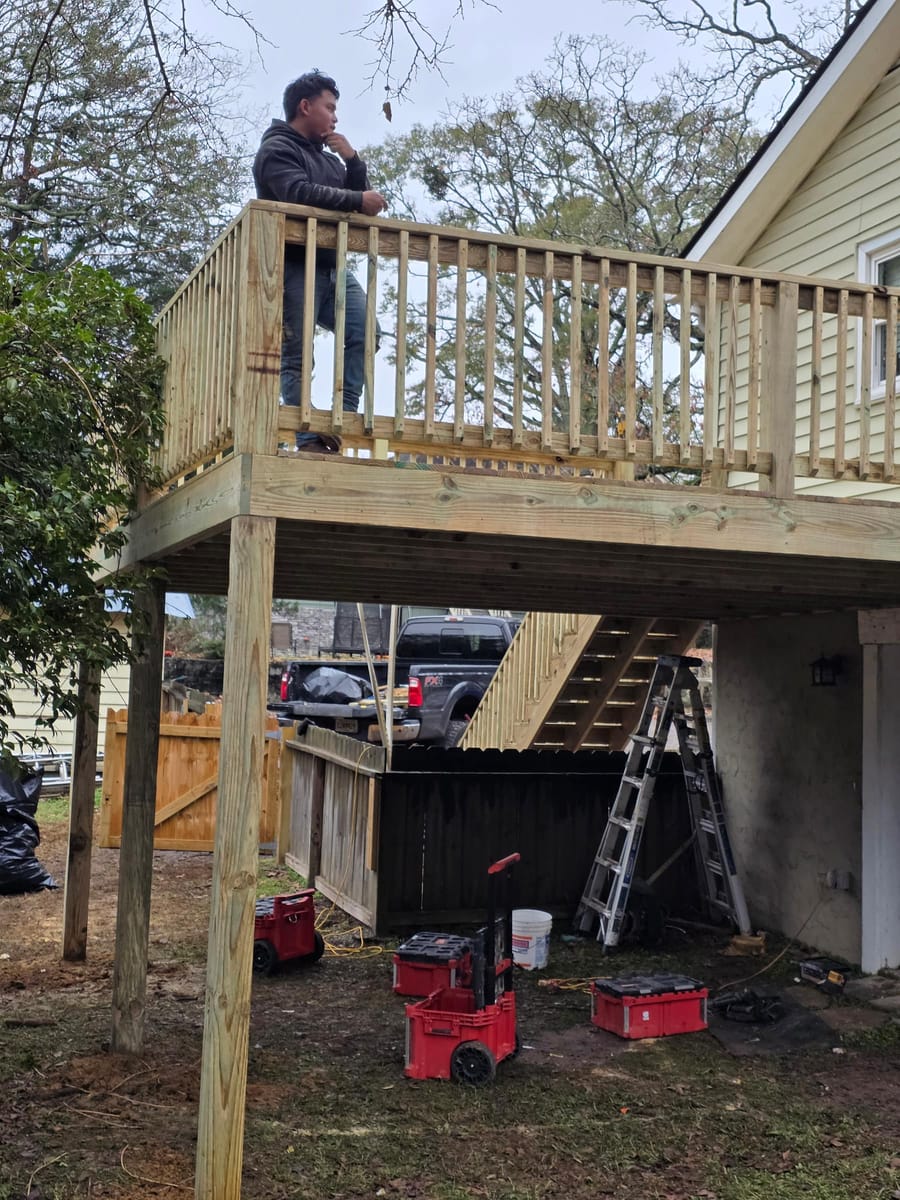
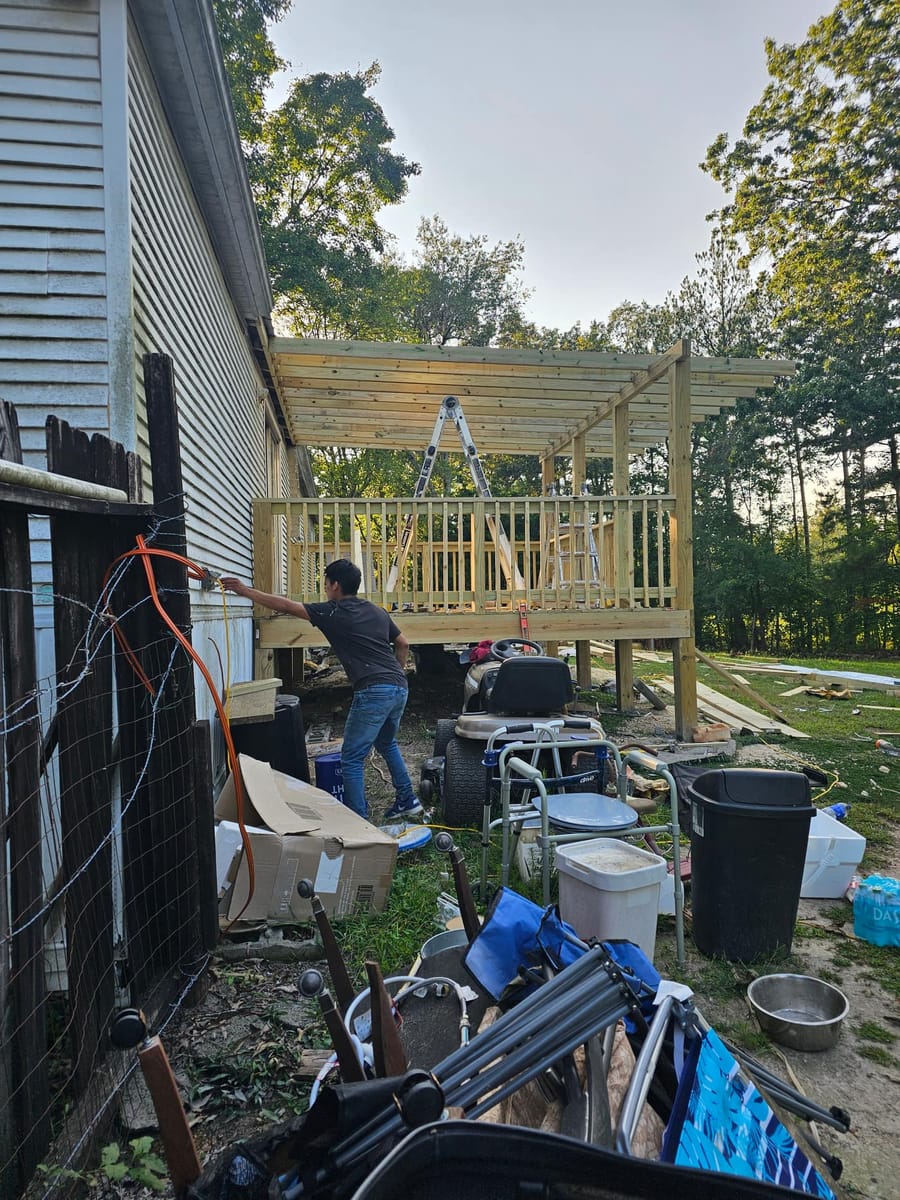
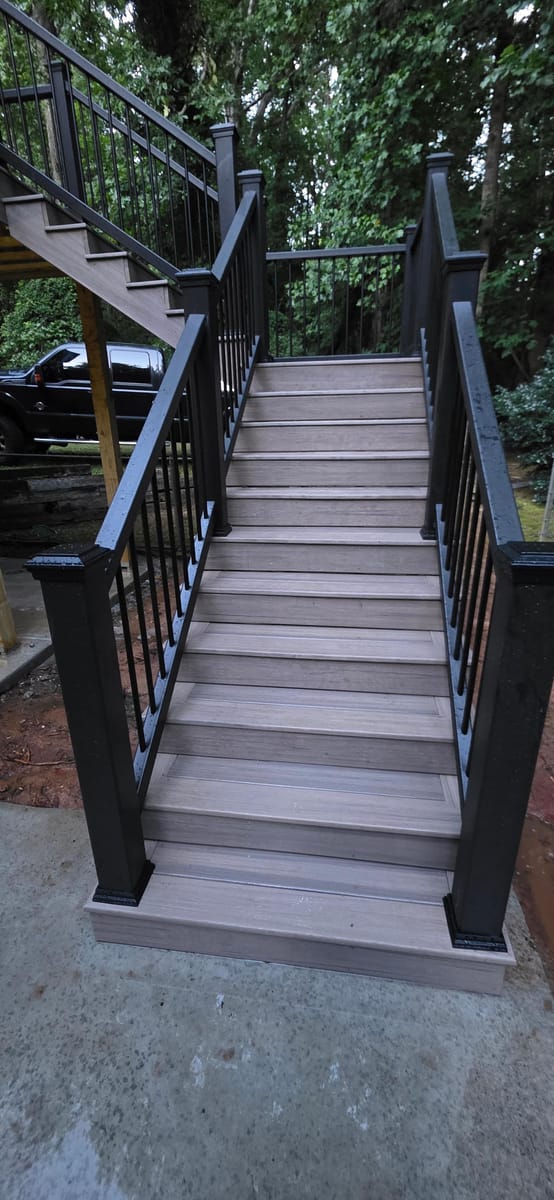
Our completed work
Common questions
Questions people ask about this
What are the main types of fence?
Chain link, wood picket, wood privacy, board on board, shadowbox, horizontal slat, vinyl privacy, ornamental aluminum, and ranch or split rail. Each one answers a different question about containment, privacy and appearance.
Composite or wood decking?
Composite costs more to install and nothing to maintain. Wood costs less to install and wants cleaning and re-coating every few years. If you plan to keep the house a long time, composite usually wins on total effort.
What's the difference between a porch, a patio and a deck?
A patio sits on the ground and is made of masonry. A deck is a framed wooden or composite platform, usually raised. A porch is a roofed structure attached to the house. The roof is what makes a porch a porch.
How long does a wood fence last in Georgia?
The posts decide it, not the boards. A pressure treated fence with properly set posts outlasts one with shallow posts by a wide margin, and the boards can be replaced along the way.
What's the best fence for dogs?
Height and the gap at the bottom matter more than material. A digger needs the fence carried down to grade or a barrier at the base. A jumper needs height. A chewer shouldn't be behind wood.