
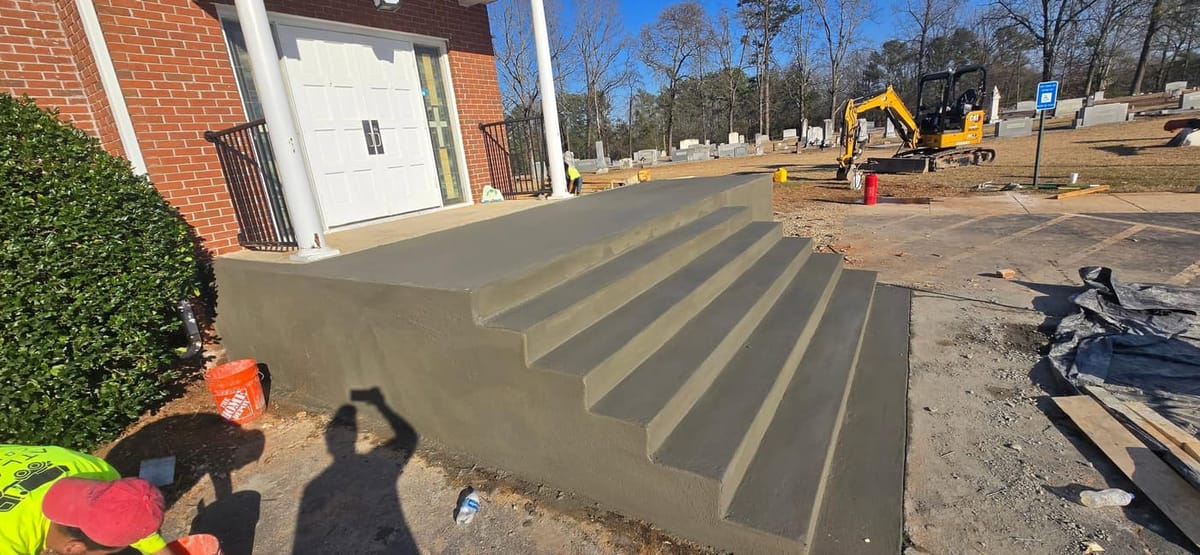
Finished steps after the forms came off, Smyrna, Georgia
The ground keeps sending water up
Soil under a slab is damp almost all the time, and a slab isn't waterproof. Whether that matters depends entirely on what you're going to put on top.
Northwest Georgia and the north Atlanta metro
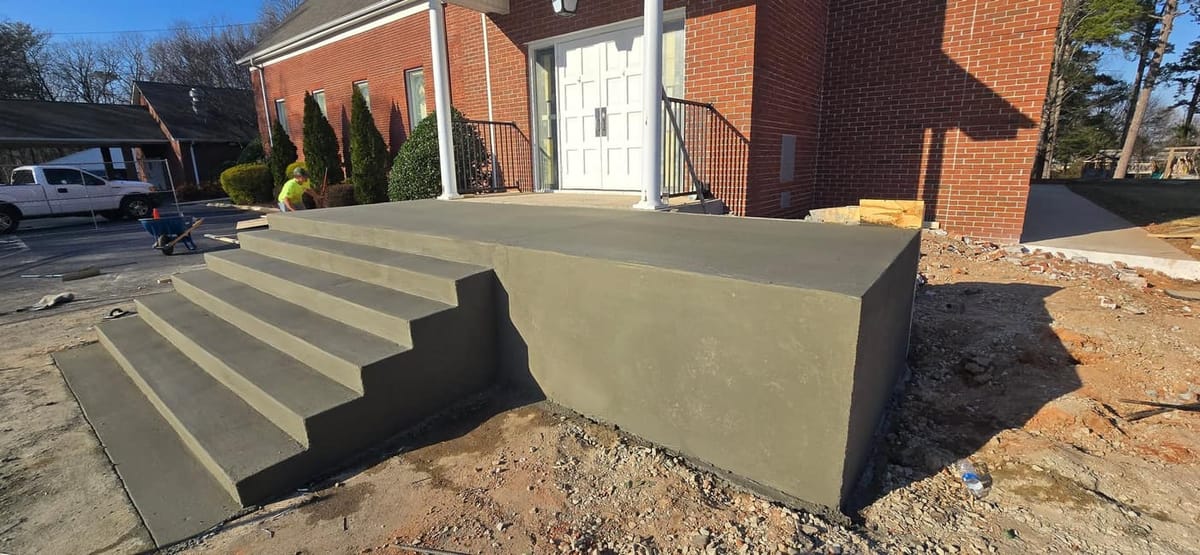
It looks solid and it's not sealed. Concrete is full of very fine connected pores, and water moves through them steadily by wicking, not by leaking. The soil under a slab is damp nearly all the year, so there's always moisture arriving at the underside and leaving from the top.
Outdoors, in the open, that's fine. It evaporates and nobody ever knows.
Put a building, a floor covering or stored belongings on top and it has nowhere to go. That's the single question that decides how a pad gets built: is this slab going to stay open to the air.
A sheet under the slab doesn't keep the concrete dry. It stops liquid water and vapor from the ground entering the slab from below, so the only moisture in it is the water it was mixed with.
That water leaves over the following weeks and then the slab settles down. Without the sheet there's no settling down, because the ground keeps supplying more. It's a thin sheet of plastic and it's the difference between a dry shed and a damp one, which is a poor ratio of cost to consequence in the direction of just putting it in.
Everything a slab touches moves at a different rate than the slab does. A house sits on footings dug below the frost and moisture zone and stays roughly where it is. A pad sits near the surface, in ground that swells when it rains and shrinks when it dries.
Pour the two hard against each other and you have connected two things that disagree about where they should be. An isolation joint is a compressible strip between them, and it lets the slab rise, fall and shrink without dragging on the building.
The same applies at a column, a post footing or an older slab.
A slab doesn't care what something weighs. It cares how much weight is landing on how small an area.
A car spread across four tires is gentler on concrete than a jack stand under one corner of it. A hot tub is the clearest example. Full, with people in it, it's heavy, and all of that is concentrated inside a footprint a few feet across.
The same applies to equipment feet, post bases and anything with legs. So the question at quoting is never just how big, it's what's standing on it and on how many points.
For a patio, both work and they fail differently. A poured slab is one continuous surface. It's fast, it's smooth, it has no joints to weed, and when it eventually cracks the crack runs across the whole thing.
Laid units flex with the ground and any one of them can be lifted and reset, at the cost of joints that need occasional attention. If something is likely to be dug up underneath later, units win easily. If the surface needs to be smooth, seamless and swept clean in a minute, concrete wins.
For jointing, reinforcement and curing across all poured work, see concrete contractor. For anything carrying vehicles, see concrete driveways.
For the paver version of a patio and how its base is built, see patios, walkways and steps. To hold a grade before a pad can go in, see retaining walls. To cover a finished slab, see pergolas and patio covers.
Our work
Finished steps after the forms came off, Smyrna, Georgia
Three quick steps. We call you back ourselves, and nothing here commits you to anything.
We call back ourselves, so the number that rings you will be (706) 879-8873. If you would rather not wait, call us now at (706) 879-8873.
Got a photo of the spot? Text it to (706) 879-8873. It answers more than a paragraph does, and it reaches the same phone as your request.
What actually happens
Organic material comes out and the exposed ground is compacted in passes. Where the soil is soft or heavy clay, a fabric between the soil and the stone stops the two mixing during a wet spell.
Crushed stone gives drainage and a level bearing surface. Under anything that will be enclosed, stored on or lived on, a sheet goes over the stone to stop ground moisture rising through the finished slab.
The forms set the edge, the thickness and the fall. A pad next to a building is set so water leaves the building, and a freestanding pad is still given a slope, because a genuinely flat slab holds every puddle that lands on it.
Mesh or bar is supported so it sits within the slab, not beneath it. Steel pressed into the subgrade by the first boot that steps on it is not reinforcing anything.
Where the new slab meets a house, a footing or an older pour, a compressible separation goes in. Those things settle on their own schedule, and a slab rigidly attached to them cracks at the junction.
Questions we get asked
If anything stored in there can be damaged by damp, yes. Ground moisture moves up through concrete continuously and evaporates off the top surface, which is why a sealed shed on a bare slab can smell damp and why cardboard boxes on the floor go soft. A sheet under the slab stops that at the source, and it can't be added later.
Bigger and thicker than most people assume, because a filled tub with people in it is a very concentrated load in a small footprint. The pad also has to be genuinely flat under the tub itself, not sloped, so the shell is evenly supported, which changes how drainage around it is handled.
It can be, and it's a common way to save a day and lose a slab. Soil holds water, drains slowly and moves with the season, especially the red clay through this part of Georgia. A stone layer under the concrete gives it a stable bearing and lets water move away instead of collecting against the underside.
Usually because it was poured tight against the foundation. The house sits on footings well below the surface and barely moves. The slab sits near the surface and moves with the ground. If the two are cast tight against each other, that difference has to be absorbed somewhere, and it gets absorbed as a crack along the join.
Flat enough that furniture doesn't rock and water doesn't stand, which are two goals slightly in tension. A slab is finished to a deliberate fall, not to dead level, and the fall is small enough that you wouldn't notice it walking on it. Perfectly level outdoor concrete is a puddle waiting for rain.
Yes, with adjustments. Cold slows the reaction that gives concrete its strength, and a slab that freezes before it has gained enough of that strength can be damaged permanently. The pour gets planned around the forecast and protected afterward instead of left to take its chances overnight.
Where we work
Tell us the rough size and what's going to sit on it, and whether it'll be covered.