
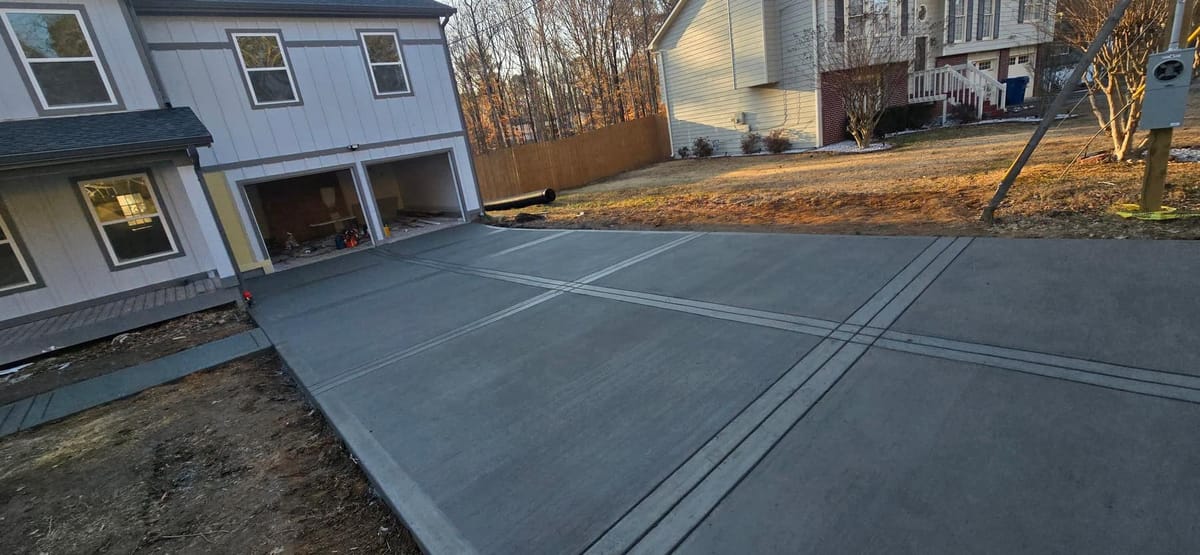
Finished driveway with cut control joints, Duluth, Georgia
It cracks on purpose or it cracks on its own
Every slab of concrete cracks. The only question settled in advance is whether the cracks land where somebody decided or wherever the slab felt like it.
Northwest Georgia and the north Atlanta metro
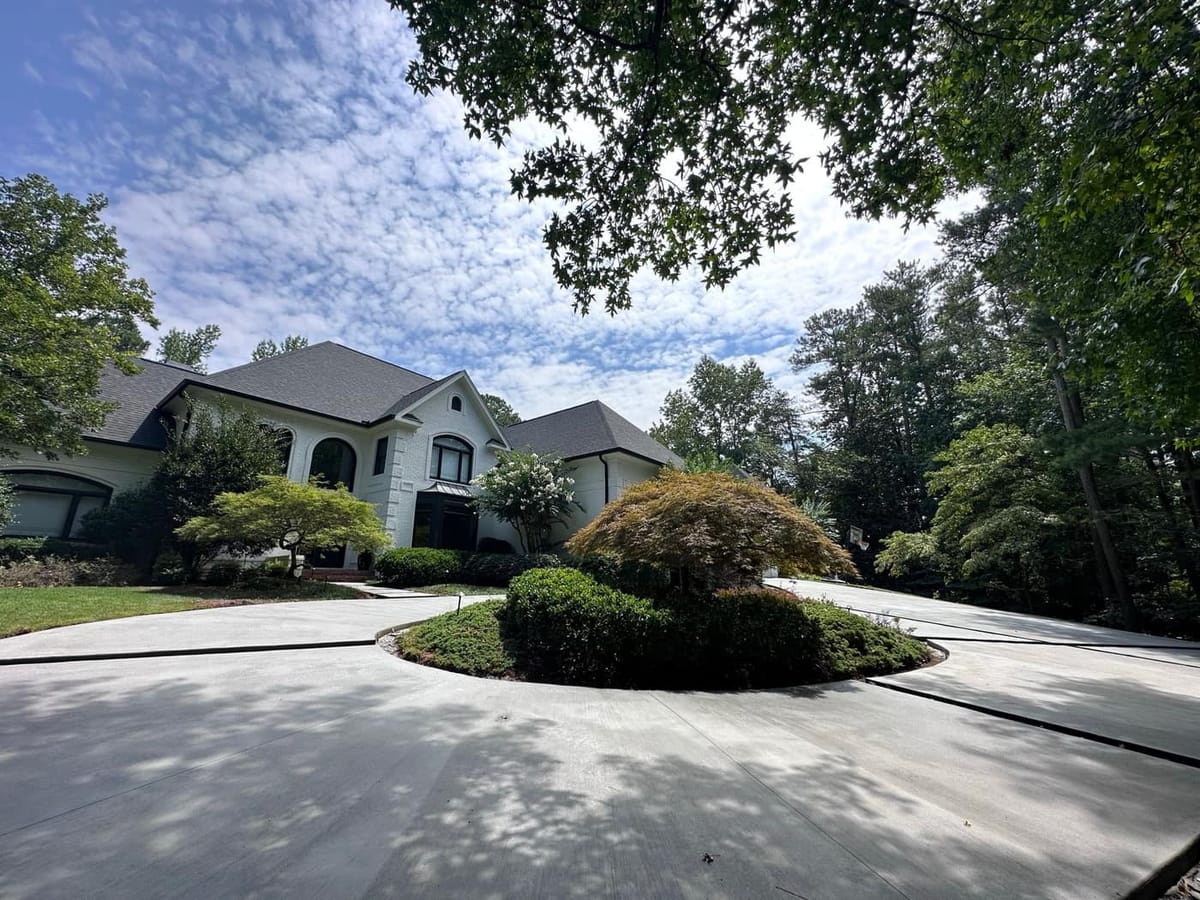
Push down on concrete and it's enormously strong. Pull it apart and it's weak, and almost everything that goes wrong with a slab is a pulling force, not a pushing one.
Shrinkage pulls. Ground settling under one end pulls. A tree root lifting a corner pulls.
That single fact explains the steel, the joints and the base preparation all at once. None of them make the concrete harder. They all deal with the direction it's weak in.
A slab spreads load across the ground underneath it, and it can only do that if the ground underneath is even. Leave a soft pocket and the slab bridges over it, unsupported, until something heavy crosses and it breaks.
So the ground is brought to a consistent firmness instead of a consistent look. Soft spots get dug out and replaced with compacted stone instead of being smoothed over, because a smooth soft spot is still a soft spot. It's worth saying plainly that this is the part nobody sees and the part that decides the outcome.
As concrete cures it gets slightly smaller. A slab is held by friction against the ground and by anything it's poured against, so it can't shrink freely. Something has to give, and concrete gives by cracking.
A control joint is a groove cut partway through the slab, which makes that line the thinnest section and therefore the weakest. The crack still happens. It happens under the groove, out of sight, in a straight line that reads as part of the pattern.
Timing matters more than depth here. Joints cut too late arrive after the slab has already chosen its own line.
This is the most misunderstood part of concrete and the reason two identical looking slabs can behave differently in five years. Concrete hardens through a chemical reaction between cement and water, not by water evaporating away.
The reaction needs that water to continue, and it continues for weeks. A slab poured on a hot, windy day and left alone loses surface water fast. The reaction near the top stops early.
What you get is a slab that's strong in the middle and soft on the surface, which shows up later as dusting, scaling and shallow flaking. Keeping a fresh pour damp costs almost nothing on the day and can't be added afterward.
Old concrete usually has to come out before new concrete goes in. Pouring a thin layer over a failed slab inherits every crack and every soft spot underneath it, and the new surface tracks the old one within a season or two.
Breaking out also gives access to the ground, which is the only chance to fix the drainage or the settlement that broke the first slab. If the original slab cracked because water was running under it, the second one will crack for the same reason.
For vehicle loading, aprons and how a long drive is jointed, see concrete driveways. For pads, patios and flatwork against a house, see concrete slabs. For pavers and stone instead of a poured surface, see patios, walkways and steps, and for holding a grade before any of it, see retaining walls.
Concrete also goes under other work. Decks land on poured pads and stairs land on poured landings. That's deck building and deck railings and stairs.
Our work
Finished driveway with cut control joints, Duluth, Georgia
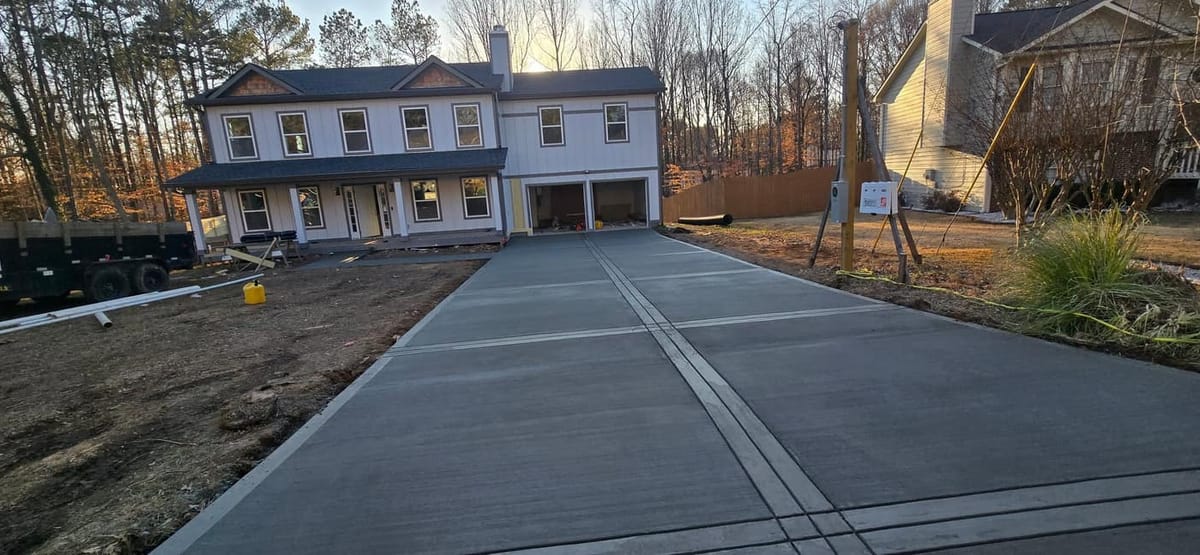
Wide drive running to the double garage, Duluth, Georgia
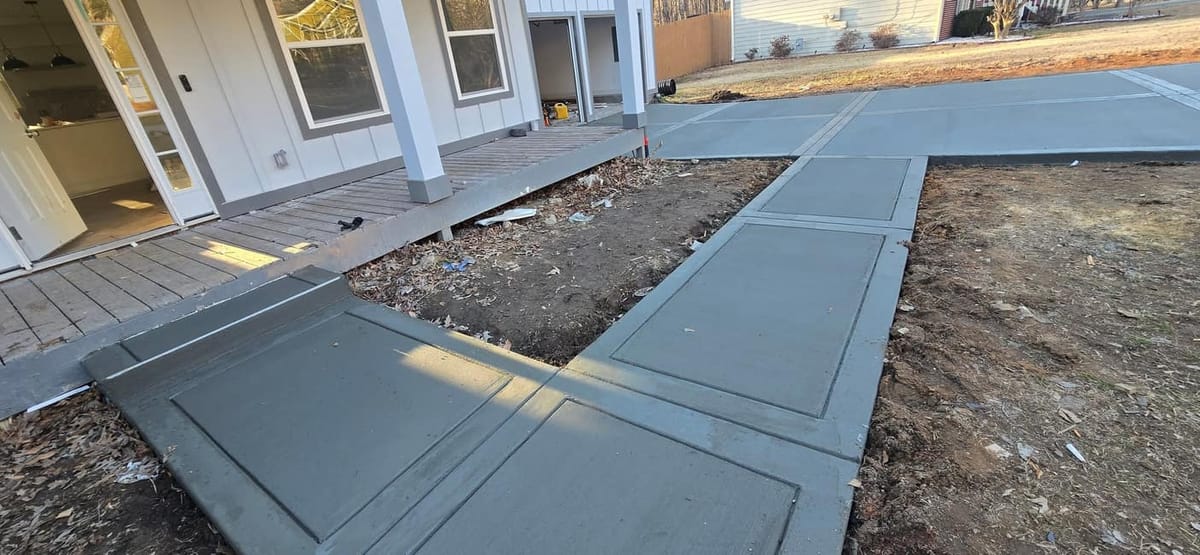
Finished walkway to the front door, Duluth, Georgia
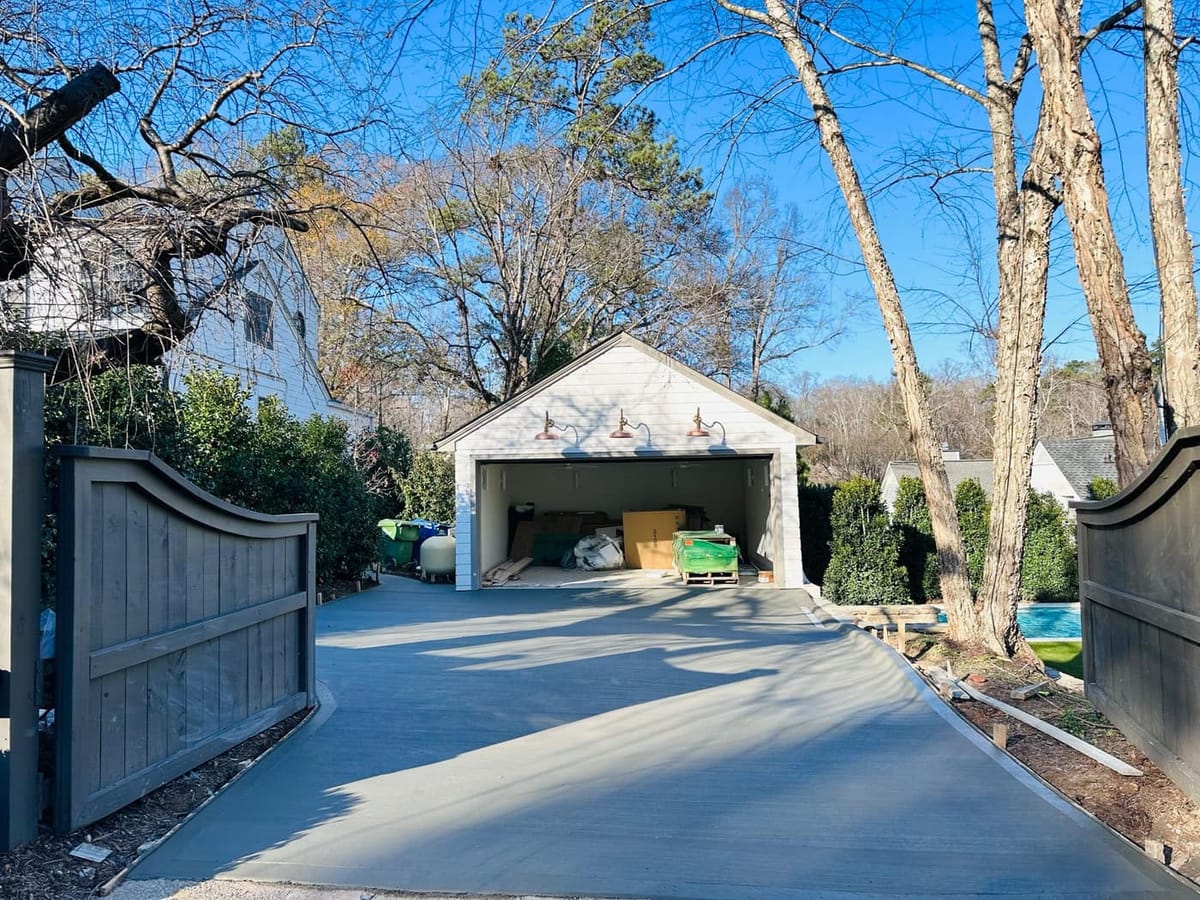
Finished drive running to the detached garage, Marietta, Georgia
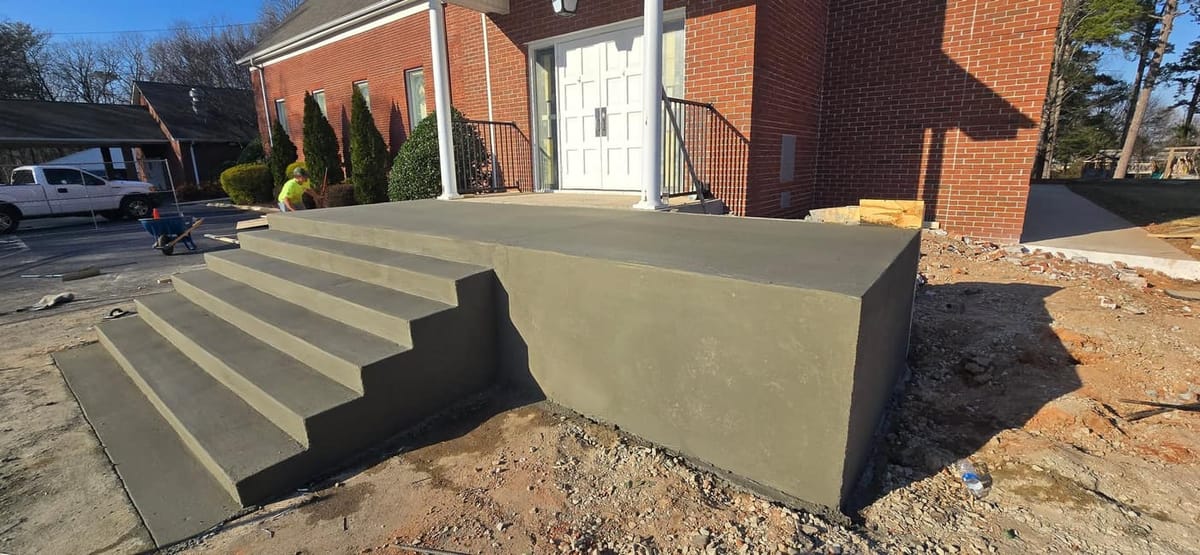
Finished steps and landing, Smyrna, Georgia
Three quick steps. We call you back ourselves, and nothing here commits you to anything.
We call back ourselves, so the number that rings you will be (706) 879-8873. If you would rather not wait, call us now at (706) 879-8873.
Got a photo of the spot? Text it to (706) 879-8873. It answers more than a paragraph does, and it reaches the same phone as your request.
What actually happens
Topsoil is organic and keeps breaking down under whatever is laid on it. It comes out, and what stays is compacted in shallow passes. A slab is only as flat as the ground it was poured on is stable.
A walkway carrying people and a driveway carrying a loaded truck aren't the same pour at different sizes. Depth is set by what will sit on it, and adding an inch of concrete is far cheaper than replacing a slab that was an inch short.
Mesh or bar does nothing lying on the subgrade, which is where it ends up if it's not held. Held up on chairs so it sits inside the depth of the slab, it holds the two sides of a crack together and stops them separating.
Concrete shrinks as it dries and it'll relieve that stress somewhere. Joints cut early and deep enough give it a straight line to do it along, which is why a jointed slab cracks in the joint instead of across the middle.
Concrete doesn't dry, it reacts with water, and that reaction runs for weeks. A slab allowed to lose its water in the first days ends up weaker and dustier on the surface than the same mix kept damp. This is the cheapest step and the most often skipped.
Questions we get asked
Yes. Concrete shrinks as it cures and it relieves that shrinkage by cracking, and no mix, thickness or reinforcement stops that. What good work does is decide where. Control joints give the slab a weakened line to crack along, so the crack opens inside a tooled groove where it reads as a line in the surface instead of wandering across the middle.
For most residential flatwork the difference matters less than the placement. Either one has to sit inside the slab, not under it, and steel resting on the subgrade is doing nothing at all. Bar is stiffer and easier to hold at the right height, which is part of why it gets specified on thicker pours.
Foot traffic comes first, then light vehicles, then anything heavy, and the gap between those is measured in days, not hours. Concrete keeps gaining strength for weeks after it stops feeling wet. Parking a loaded trailer on a slab that's still green is a good way to crack it in its first month.
It can, and the join needs to be treated as a joint instead of a seam. Two slabs poured at different times move independently, so they're separated deliberately instead of joined and left to argue with each other. Where they meet the house or a footing, the same thinking applies.
Yes. Texture and color go in while the concrete is still plastic, so the finish is decided before the pour. Tell us what you're after at the quote stage and it gets planned into the day, since it changes the crew size and the timing on site.
Usually efflorescence, which is mineral salt carried to the surface as moisture moves out through the slab. It's a surface deposit, not damage, it's common on new work, and it generally weathers off over the first year. It tends to be more visible on slabs that stayed wet underneath.
Where we work
Tell us roughly how big the area is and what will be driving or sitting on it.